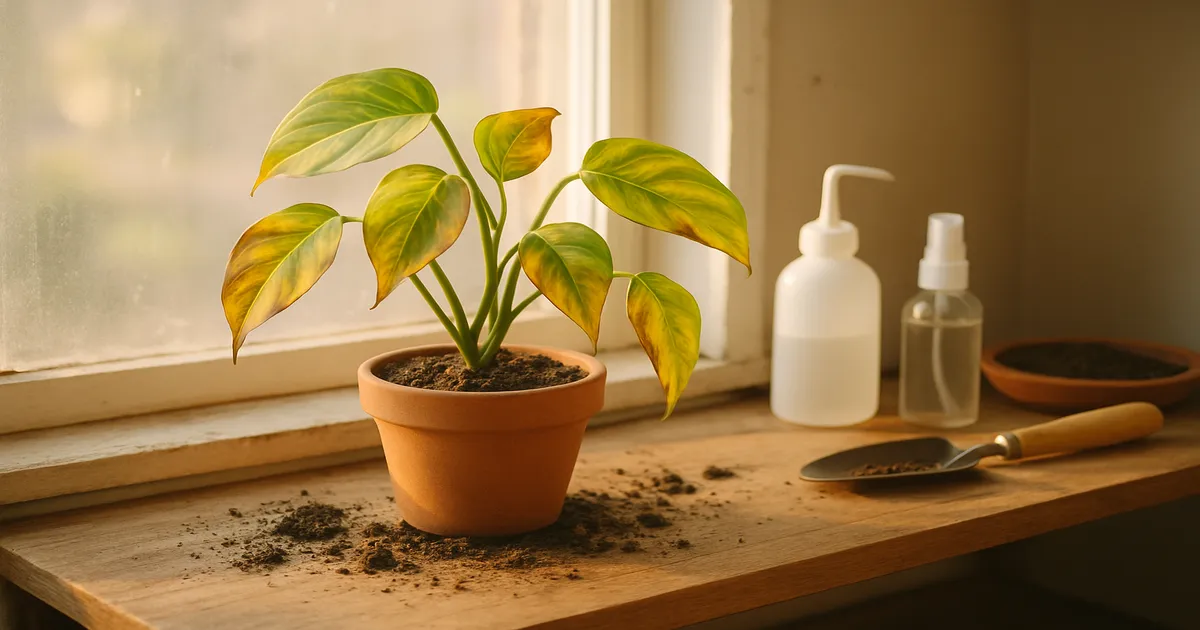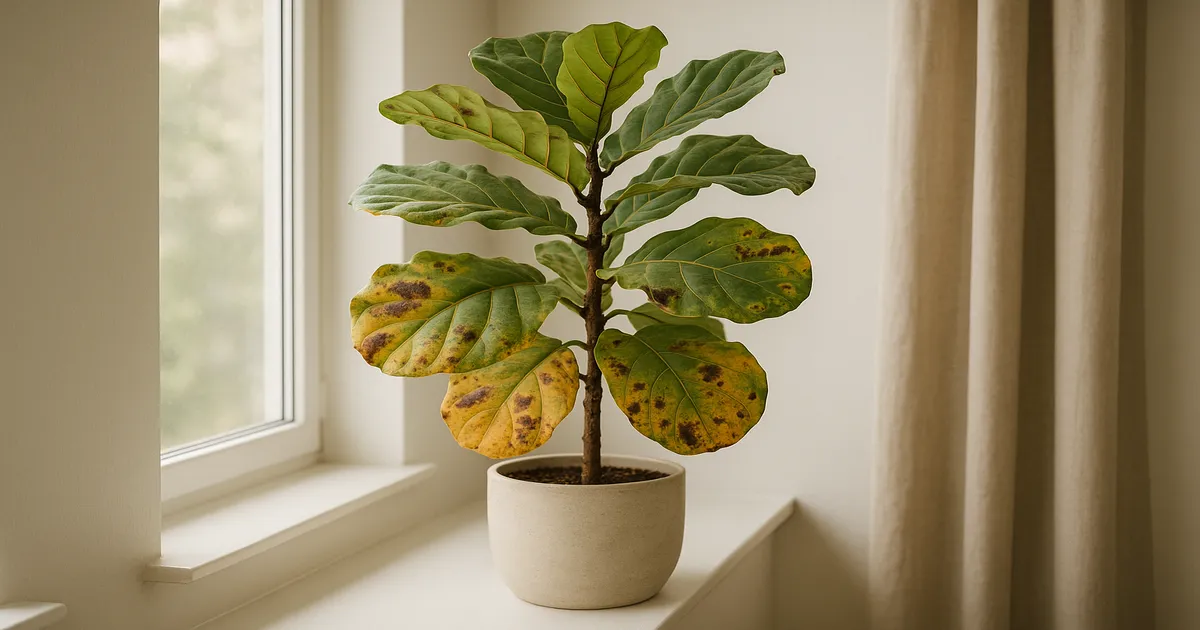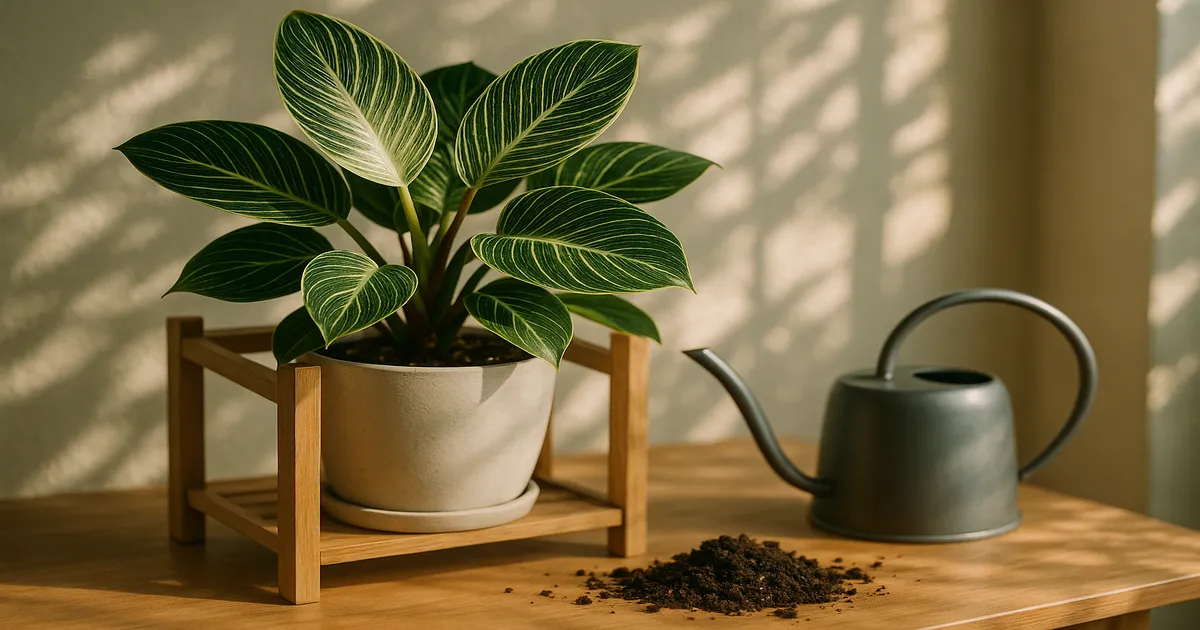
Quick Answer: The most common reasons your Philodendron Birkin is struggling are overwatering, incorrect light, or the plant’s natural chimeric variegation shifting — none of which signal permanent damage if caught early. Nine distinct problems can affect Birkins, from root rot and pest infestations to nutrient deficiencies and environmental stress. Use the symptom table below to pinpoint your issue, then jump straight to the fix.
What Is Wrong With My Philodendron Birkin? The 9 Most Common Problems
The Birkin is not a wild species — it’s a cultivated chimeric cultivar that likely mutated from Philodendron ‘Rojo Congo’ during tissue culture propagation. That origin matters. Because it has never had to adapt to a real-world environment, it’s more sensitive to care inconsistencies than most philodendrons. Small mistakes compound quickly.
Here are the nine problems this guide covers:
- Overwatering and root rot
- Underwatering and drought stress
- Too little or too much light
- Variegation reversion or over-variegation
- Nutrient deficiencies or fertilizer salt buildup
- Pest infestations
- Environmental stress (temperature, humidity, drafts)
- Root-bound conditions and degraded soil
- Bacterial, fungal, or viral disease
Symptom Quick-Reference Table
Find your symptom below, then skip to that section for a full diagnosis and fix.
| Symptom | Most Likely Cause |
|---|---|
| Yellow, mushy lower leaves | Overwatering / root rot |
| Curling, crispy brown edges | Underwatering or low humidity |
| Leggy growth, leaves going green | Too little light |
| Bleached or scorched patches | Too much direct sun |
| Pinstripes fading or disappearing | Variegation reversion |
| Yellow leaves with green veins (new growth) | Iron deficiency |
| Uniform pale yellowing (older leaves) | Nitrogen deficiency |
| Stippling, webbing, or sticky residue | Pest infestation |
| Black spots with yellow halos | Bacterial leaf spot |
| Roots circling pot, stunted growth | Root-bound conditions |
Ideal Care Parameters
| Parameter | Ideal Range |
|---|---|
| Light | Bright indirect light (1,500–3,000 foot-candles) |
| Temperature | 18–29°C (65–85°F) |
| Humidity | 50–70% relative humidity |
| Soil pH | 5.5–6.5 |
| Watering | When top 2–5 cm (1–2 in) of soil is dry |
| Fertilizer | Balanced NPK, half-dose, monthly in spring–summer |
What Is Wrong With My Philodendron Birkin’s Leaves? Watering Problems Explained
Signs Your Birkin Is Overwatered
Overwatering is the single most common reason a Birkin declines. Watch for:
- Yellowing leaves starting at the bottom of the plant
- A mushy or blackened stem base
- Wilting even though the soil feels wet
- A foul, sulfurous smell from the potting mix
- Leaves that feel soft and limp rather than firm
How Root Rot Develops — and Why It Moves Fast
Saturated soil drives oxygen out of the root zone, creating anaerobic conditions that fuel pathogens like Pythium, Phytophthora, and Fusarium. These organisms decompose root tissue quickly. By the time symptoms appear above the soil, significant root damage has often already occurred.
To treat root rot:
- Unpot the plant and inspect the roots. Healthy roots are white to tan and firm; rotted ones are brown or black and mushy.
- Prune all rotted roots with sterile scissors, cutting back to healthy tissue.
- Rinse remaining roots with a dilute hydrogen peroxide solution (3% H₂O₂ mixed 1:4 with water).
- Repot into fresh, well-draining aroid mix in a pot with drainage holes — unglazed terracotta is ideal because it wicks excess moisture.
- Withhold water for 3–5 days to let cut roots callous over.
- For severe cases, drench the root zone with a biological fungicide containing Trichoderma spp. or Bacillus subtilis.
Signs Your Birkin Is Underwatered
When the root zone dries out completely, turgor pressure collapses. Prolonged drought causes irreversible damage to fine root hairs. Symptoms include:
- Leaves curling inward (a stress response that reduces water loss)
- Dry, crispy brown tips and edges
- Soil pulling away from the pot edges
- A noticeably lightweight pot
Fix: Bottom-water the plant by setting the pot in a basin of room-temperature water for 20–30 minutes. If the soil has become hydrophobic and repels water, add a single drop of liquid dish soap to break surface tension.
The Key Diagnostic: Overwatering vs. Underwatering
Overwatered leaves are soft and mushy. Underwatered leaves are crispy and papery. Both can cause yellowing and wilting, but the texture of the damaged tissue tells you exactly which direction you’ve gone wrong.
Light Problems: Too Little or Too Much
Symptoms of Insufficient Light
Low light is a double problem for a chimeric plant. Without enough energy, the Birkin compensates by producing more chlorophyll-containing cells — which means less variegation over time. It also causes longer, leggier petioles (etiolation), smaller new leaves, and soil that stays wet far longer than usual because the plant simply isn’t transpiring enough.
Symptoms of Too Much Direct Sunlight
The white sections of each leaf contain no photoprotective pigments, so they scorch faster than you’d expect. Direct sun damage looks like irregular bleached, tan, or white patches — these are crispy and dull, distinct from the clean, bright appearance of true variegation. Scorched leaf tips and an overall washed-out color are also common.
The Best Light Conditions for a Philodendron Birkin
Aim for bright indirect light (1,500–3,000 foot-candles). Position the plant 60–120 cm from an east- or north-facing window. South- or west-facing windows work if the light is filtered through a sheer curtain. In winter or darker rooms, a full-spectrum LED grow light on a 12–14 hour timer replicates ideal conditions reliably. The Soltech Aspect is a popular option that fits naturally above a plant stand without looking clinical. Whatever you do, avoid sudden large light changes — acclimate the plant gradually over one to two weeks.
Variegation Changes: Why Your Birkin Is Turning Green or Going All White
What Causes Variegation Reversion?
The white pinstripes are produced by cells that lack chlorophyll-producing plastids. The ratio of these cells to green cells in the growing tip (meristem) is never fully fixed. Stress, low light, rapid temperature swings, or random cell sorting can all tip the balance toward more green cells. The result: new leaves emerge with fewer or no pinstripes.
The most effective fix is to increase light to bright indirect (1,500–3,000 foot-candles). If a stem has reverted completely, prune it back to a node that showed good variegation — new growth from that node has a better chance of re-expressing the pattern.
Why Nearly All-White Leaves Are a Problem
All-white leaves look striking, but they’re a liability. Without chlorophyll, they can’t photosynthesize, so the rest of the plant has to support them. If your Birkin is pushing mostly white leaves, increase light slightly and keep fertilization consistent — the green leaves need all the help they can get.
The Pink or Red Leaf Phenomenon
Occasionally a Birkin produces leaves with pink or red patches. This is a partial reversion toward its ‘Rojo Congo’ parent and is completely normal. It’s not a disease, not a deficiency, and not something you need to fix. Many growers prize these leaves.
Can You Restore Lost Variegation?
Only partially, and never with certainty. No fertilizer or supplement can reliably reprogram chimeric cell expression. Improving light is your best lever. Pruning reverted growth gives the plant a chance to express better variegation from a new growing point — but there are no guarantees. Managing expectations is part of owning a Birkin.
Nutrient Deficiencies and Fertilizer Problems
Nitrogen Deficiency: Uniform Yellowing of Older Leaves
Nitrogen is mobile in plants. When supplies run low, the plant pulls it from older leaves to fuel new growth, causing uniform pale yellowing that starts at the bottom and works upward. A balanced liquid fertilizer at half dose, applied monthly during spring and summer, usually resolves this within a few weeks.
Iron Deficiency: Interveinal Chlorosis on New Leaves
If the newest leaves are yellowing between the veins while the veins themselves stay green, iron deficiency is the likely culprit. Iron is immobile, so symptoms always appear on new growth first. The most common cause isn’t a lack of iron in the soil — it’s a pH above 6.5, which chemically locks iron out of the plant’s reach. Test your soil pH and, if needed, apply a chelated iron supplement as a foliar spray or soil drench.
Magnesium and Calcium Deficiency
Magnesium deficiency looks similar to iron deficiency — interveinal chlorosis — but it appears on older leaves, not new ones, because magnesium is mobile. Epsom salt (magnesium sulfate) at one teaspoon per liter of water, applied as a monthly soil drench, is a straightforward fix.
Calcium deficiency shows up differently: distorted, cupped, or stunted new growth with brown margins on young leaves. Because calcium is immobile, it can’t be redirected from older tissue, so new growth always suffers first.
Fertilizer Salt Buildup: When Too Much Fertilizer Causes Brown Tips
Over-fertilizing leaves salt deposits in the soil that create osmotic stress — essentially pulling water away from roots. The symptom (crispy brown tips) looks almost identical to drought stress, which makes it easy to misdiagnose. If you suspect salt buildup, flush the soil thoroughly with plain water — roughly three to four times the pot volume — then resume a diluted fertilizer schedule.
Use a balanced NPK fertilizer such as Jack’s Classic All Purpose (20-20-20) at half the recommended dose, once a month from spring through summer. Pause entirely in winter. Less is consistently more with Birkins.
Pests Attacking Philodendron Birkin
Spider Mites
Spider mites cause a distinctive bronze or silver stippling across the leaf surface. Fine webbing on leaf undersides — especially near the petiole junction — is the telltale sign. They thrive when humidity drops below 40%. Blast the leaves with water first, then apply neem oil or insecticidal soap, repeating every five to seven days for three weeks.
Mealybugs
Mealybugs hide in the joints between leaves and stems, leaving behind white cottony clusters and sticky honeydew. Dab individual bugs with 70% isopropyl alcohol on a cotton swab, then follow up with a neem oil soil drench weekly until clear.
Fungus Gnats
The adult gnats are more annoying than harmful — it’s their larvae that damage roots by feeding on organic matter and fine root hairs. Let the soil dry more between waterings (larvae need moisture to survive) and apply a Bacillus thuringiensis var. israelensis (Bti) drench to kill larvae biologically. Mosquito Bits work well for this and are widely available. Yellow sticky traps handle the adults.
Scale, Thrips, and Root Mealybugs
- Scale: Look for small brown or tan bumps on stems that don’t wipe off easily. Scrape them off manually, then apply horticultural oil every 10–14 days.
- Thrips: Silvery streaking and distorted new growth, with tiny fast-moving insects and black fecal dots on leaves. Spinosad-based insecticide is the most effective treatment; repeat every five to seven days.
- Root mealybugs: You won’t see these until you unpot the plant. A white waxy coating on roots explains otherwise-mysterious wilting and stunted growth. Wash all old soil from the roots and apply a systemic neem drench after repotting.
Pest Treatment: Step-by-Step
- Isolate the affected plant immediately to prevent spread.
- Identify the pest before treating — the wrong product wastes time.
- Start with the least aggressive method: manual removal, then insecticidal soap or neem oil.
- Escalate to systemic treatments (Bti, spinosad) only if needed.
- Repeat treatments on schedule — one application rarely eliminates an infestation.
- Maintain humidity above 50% to deter spider mites long-term.
Environmental Stress, Root-Bound Conditions, and Disease
Cold, Heat, and Draft Injury
The Birkin has no cold-hardening ability. Temperatures below 12°C (55°F) cause chilling injury — dark, water-soaked patches that turn brown or black, sudden leaf drop, or wilting concentrated on the side facing a cold window or air vent. Heat above 35°C (95°F) causes wilting and bleaching even in well-watered plants. Keep the Birkin away from exterior doors, air conditioning vents, and cold windowpanes in winter.
Low Humidity and Leaf Tips
Brown, crispy leaf tips that start at the very tip and work inward are the signature of low humidity — not underwatering, though the two often occur together. The Birkin wants 50–70% relative humidity. A small humidifier placed nearby is the most reliable solution; the Levoit Classic 300S is a good fit for most indoor plant setups. Grouping plants together and using a pebble tray with water offer more modest boosts.
Signs Your Birkin Is Root Bound
As roots fill the pot, they compress the growing medium and reduce drainage — which paradoxically mimics overwatering symptoms even when you’re watering correctly. Signs it’s time to repot:
- Roots circling the bottom of the pot or emerging from drainage holes
- Water rushing straight through without being absorbed
- Stunted growth despite adequate light and feeding
- Lower leaves yellowing for no apparent reason
Repot into a container one size up (5 cm / 2 in larger in diameter) using fresh mix. Old potting medium also breaks down after 12–18 months, losing its porosity regardless of root density — a good reason to refresh the soil annually even if the plant isn’t visibly root-bound.
Bacterial Leaf Spot, Botrytis, and Dasheen Mosaic Virus
Three diseases are worth knowing by name:
- Bacterial leaf spot (Erwinia or Pseudomonas spp.): Brown or black spots with distinct yellow halos, spreading via water splash or wounds. Remove affected leaves, avoid wetting foliage, and improve air circulation.
- Botrytis (gray mold): Fuzzy gray patches on leaves or stems, typically in cool, humid, stagnant conditions. Improve airflow and reduce humidity slightly; remove affected tissue promptly.
- Dasheen mosaic virus (DsMV): Mosaic yellowing and distorted growth that can be confused with chimeric variegation changes. There is no cure — infected plants should be isolated and eventually discarded to protect other plants in your collection.
Prevention: Keeping Your Philodendron Birkin Healthy Long-Term
The Best Potting Mix for a Philodendron Birkin
A good aroid mix drains fast but retains just enough moisture. A reliable DIY recipe:
- 1 part quality potting soil (Fox Farm Ocean Forest works well)
- 1 part perlite
- 1 part orchid bark (medium grade)
This combination provides excellent aeration, prevents compaction, and gives roots the oxygen-rich environment they need. Avoid standard potting mixes on their own — they hold too much water for a Birkin.
Watering Correctly: The Moisture Meter Method
Forget watering calendars. Soil dries at different rates depending on season, pot size, humidity, and light levels. A moisture meter removes the guesswork entirely: water when the reading hits 3–4 on a standard 1–10 scale. The XLUX Soil Moisture Meter is inexpensive and accurate enough for everyday use. Always check the reading at mid-pot depth, not just the surface.
Frequently Asked Questions
Why are my Philodendron Birkin’s leaves turning yellow? Yellow leaves most often signal overwatering. Check whether the soil is staying wet for more than 7–10 days. If the leaves are also mushy, root rot may already be underway — unpot and inspect the roots. If the leaves are firm and yellowing starts on older foliage, nitrogen deficiency is more likely.
Why is my Philodendron Birkin losing its white stripes? Variegation loss (reversion) is usually triggered by low light or stress. Move the plant to a brighter spot with indirect light and prune any fully green stems back to a node that showed variegation. Results take several new leaves to appear, so be patient.
Why does my Philodendron Birkin have brown tips? Brown tips that start at the very tip and work inward typically indicate low humidity or fertilizer salt buildup. Brown tips combined with crispy edges across the whole leaf usually point to underwatering. Check humidity (aim for 50–70%), flush the soil if you’ve been fertilizing heavily, and adjust your watering routine.
How often should I water a Philodendron Birkin? There is no fixed schedule. Water when the top 2–5 cm (1–2 in) of soil is dry — this might be every 7 days in summer and every 14 days in winter. Pot size, soil mix, temperature, and light all affect the rate. A moisture meter is the most reliable guide.
Can a Philodendron Birkin recover from root rot? Yes, if caught early. Remove all rotted roots, treat with dilute hydrogen peroxide, and repot into fresh well-draining mix. Plants that have lost more than 50–60% of their root system will struggle, but many do recover with careful aftercare — reduced watering, bright indirect light, and no fertilizer until new growth resumes.