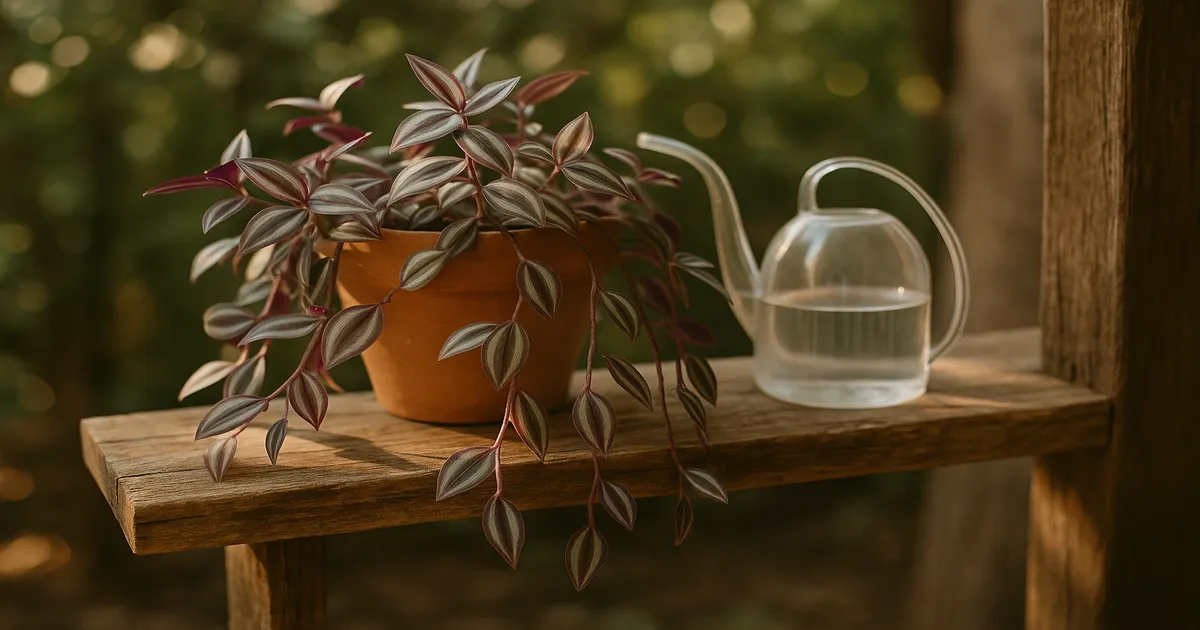
Quick Answer: Water your wandering jew when the top 1–2 inches of soil are dry but before the lower half of the pot dries out completely — typically every 5–7 days in spring and summer, and every 10–14 days in fall and winter. No fixed schedule works for every home, so always check the soil before you water rather than going by the calendar.
Figuring out how often to water wandering jew (Tradescantia) is one of those things that sounds simple until your plant starts yellowing or going crispy. The honest answer is that frequency depends heavily on your specific conditions — light, season, pot material, and more. This guide covers all four major species (T. zebrina, T. pallida, T. fluminensis, and T. sillamontana), with practical tools to nail the timing every time.
How Often to Water Wandering Jew: The Golden Rule
Check the Soil, Not the Calendar
Stick your finger into the soil up to the first or second knuckle. If the top 1–2 inches feel dry but the soil below still has some moisture, it’s time to water. If the bottom half is also dry, you’ve waited too long. If anything feels damp at the surface, put the watering can down and check again in a day or two.
A moisture meter takes the guesswork out entirely — water when the reading drops to 3–4 on a 1–10 scale.
Watering Frequency by Season
| Season | Typical Frequency |
|---|---|
| Spring & Summer | Every 5–7 days |
| Fall & Winter | Every 10–14 days (or longer) |
These are starting points, not rules. A plant in a terracotta pot on a sunny windowsill in July might need water every 4 days. The same plant in a plastic pot in a north-facing room in December might go 3 weeks between waterings.
Understanding Wandering Jew Water Needs
Native Habitat
Tradescantia species originate from the tropical and subtropical regions of Mexico, Central America, and South America, where they grow in humid forest understories and along disturbed edges. They’re adapted to consistent moisture with good drainage — not bog conditions, but never bone-dry either. That context matters when you’re trying to replicate their preferred watering rhythm indoors.
Stems, Roots, and Why Both Matter
The stems store a modest amount of water, giving wandering jew a small buffer against drought. But the root system is shallow and fibrous, with very limited reserves and high sensitivity to both waterlogging and extended dryness. Think of the stems as a tiny emergency tank — useful for a day or two, but not a substitute for consistent watering.
High leaf surface area also means rapid transpiration, especially in warm, bright rooms. The plant can lose water surprisingly fast when conditions are right.
How Species Differences Affect Watering Frequency
Not all Tradescantia are equal when it comes to drought tolerance:
- T. zebrina and T. fluminensis need the most consistent moisture. Let these dry out and you’ll see it quickly in their color and leaf texture.
- T. pallida (Purple Heart) has a thicker cuticle and handles drought noticeably better — it’s more forgiving of the occasional missed watering.
- T. sillamontana (White Velvet) is the most drought-tolerant of the group. Its fine white hair coverage (trichomes) reduces transpiration, making its needs closer to a soft succulent than a typical tropical.
Signs Your Wandering Jew Is Overwatered
Why Overwatering Is the Most Common Mistake
Waterlogged soil pushes oxygen out of the pore spaces between soil particles. Without oxygen, roots can’t respire normally — they switch to anaerobic fermentation, which damages root tissue. That damaged tissue then becomes a target for Pythium, Phytophthora, and Fusarium — the main pathogens behind root rot in Tradescantia.
Here’s the cruel irony: once root rot sets in, the damaged roots can’t transport water upward. The plant wilts. You see a wilting plant and assume it’s thirsty. You water more. The situation gets worse fast.
⚠️ Watch for this trap: A wandering jew wilting in wet soil is almost certainly overwatered, not underwatered. Check the soil before you reach for the watering can.
Overwatering Symptoms
- Yellowing leaves, starting with the lower and older ones
- Mushy, blackened stem bases
- Wilting despite soil that feels wet
- A foul, sour smell coming from the potting mix
- Fungus gnats hovering around the soil surface
Signs Your Wandering Jew Is Underwatered
What Drought Stress Does to the Plant
When soil dries out past the plant’s ability to extract moisture, cells lose turgor pressure — the internal water pressure that keeps stems firm and leaves flat. The plant also releases abscisic acid (ABA), a hormone that closes the stomata to conserve water. Even after you rewater, stomatal closure can linger, slowing photosynthesis and growth. Repeated severe drought cycles cause irreversible damage to the fine root hairs responsible for water uptake.
Underwatering Symptoms
- Crispy brown leaf tips and edges
- Leaves curling or cupping inward
- Dull, faded color — T. zebrina loses its metallic sheen noticeably
- Limp, deflated-looking stems
- Soil visibly pulling away from the edges of the pot
Fluoride and Water Quality: A Hidden Cause of Brown Tips
Brown tips aren’t always from underwatering. Tradescantia is moderately sensitive to fluoride at concentrations above 1 ppm, which is common in municipal tap water. Hard water raises soil pH over time, locking out nutrients. Chloramine (used in many water systems) can irritate roots with chronic exposure. Cold water — anything below 60°F — can cause temporary cold shock that disrupts root function. All of these can produce brown tips that look like drought damage but won’t improve no matter how much you water.
Factors That Change How Often to Water Wandering Jew
Light Levels
A plant in bright indirect light (1,500–3,000 foot-candles) is photosynthesizing hard, keeping stomata open, and losing water through transpiration at a high rate. Move that same plant to a dim corner (under 200 foot-candles) and it may need water two to three times less often. Light level is probably the single biggest variable in your watering equation.
Temperature and Season
Evapotranspiration roughly doubles for every 10°C (18°F) rise in temperature. A wandering jew at 85°F is losing water about twice as fast as one at 65°F. This is why summer watering needs jump — it’s not just about growth, it’s physics.
Humidity and Airflow
When relative humidity drops below 40%, the vapor pressure difference between the leaf and the surrounding air increases, pulling moisture out of the plant faster. Tradescantia prefers 40–60% RH. Fans and drafts compound this by accelerating evaporation from both the soil surface and the leaves, shortening your watering window.
Pot Material
Terracotta is porous — water evaporates right through the walls, reducing soil moisture retention by 20–40% compared to plastic or glazed ceramic. Plants in terracotta pots may genuinely need watering twice as often as the same plant in plastic. Neither material is wrong; it just changes your baseline.
Pot Size and Root-Bound Conditions
An oversized pot holds far more soil than the roots can draw from quickly. The outer zones stay wet for extended periods, even as the center dries — a recipe for root rot in one part of the pot and drought stress in another. Choose a pot only 1–2 inches larger in diameter than the root ball.
On the flip side, a severely root-bound plant has almost no soil buffering moisture. It can dry out completely within 24–48 hours of watering. If you’re watering very frequently and the plant still looks stressed, check whether it needs repotting.
Seasonal Watering Schedule for Wandering Jew
Spring and Summer
During active growth, wandering jew can elongate several inches per week. High metabolic activity means high water demand — every 5–7 days is a reasonable starting point in average indoor conditions. Always verify with a finger check rather than the calendar, especially during heat waves.
Fall and Winter
Even near a south-facing window, indoor light levels drop 50–70% compared to summer. Photosynthesis slows, stomata open less, and transpiration drops significantly. Cooler indoor temps slow soil evaporation too. The result: your plant needs far less water, but the soil stays wet far longer. Overwatering in winter is the most common seasonal mistake by a wide margin.
Aim for every 10–14 days as a starting point, and always check first. Some plants in low winter light need water only once every 3 weeks.
Transitioning Between Seasons
Start reducing watering frequency gradually in early autumn — don’t wait until December. Likewise, begin increasing frequency in late February or early March as light returns and you see new growth. The plant will tell you when it’s ready to drink more; watch for the soil drying out faster than it did the week before.
How to Fix Overwatering and Underwatering
Rescuing an Overwatered Wandering Jew
- Stop watering immediately. Move the plant to a spot with bright indirect light and good airflow to help the soil dry.
- Tip the pot at a 45° angle to encourage any pooled water to drain from the drainage hole.
- Unpot and inspect the roots. Healthy roots are white or tan and firm. Rotted roots are black, mushy, and smell bad.
- Trim all damaged roots with sterile scissors, then dust the cut ends with powdered cinnamon or powdered sulfur — both have antifungal properties.
- Repot into fresh, dry mix and apply a drench with a biological fungicide containing Trichoderma harzianum or Bacillus subtilis to suppress remaining pathogens.
- Wait 7–10 days before watering again to let root wounds callous.
Reviving an Underwatered Wandering Jew
- Bottom-water the plant by setting the pot in a basin of room-temperature water for 20–30 minutes. When soil dries out severely it can become hydrophobic — water poured from the top just runs down the edges without absorbing. Bottom-watering solves this.
- Trim crispy, dead foliage to reduce the plant’s water demand while it recovers.
- Hold off on fertilizer until you see new growth. Concentrated fertilizer salts on damaged roots will make things worse.
Soil Mix and Pot Choice
A well-draining but moisture-retentive mix is the goal. A good recipe:
- 60% standard peat- or coir-based potting mix (Fox Farm Ocean Forest)
- 25–30% perlite or pumice
- 10–15% coarse horticultural sand or fine orchid bark
Target a soil pH of 6.0–7.0. Outside this range, nutrients lock out even when fertilizer is applied correctly.
For pot choice: use terracotta if you tend to overwater, and plastic or glazed ceramic if your home is dry or you tend to forget waterings. Always use a pot with drainage holes. If you love a decorative cachepot, drop a nursery pot inside it and empty the cachepot after every watering.
Prevention: Keeping Your Wandering Jew Perfectly Watered
Check, Don’t Schedule
Set a reminder to check your plant every 3–4 days rather than watering on a fixed day. Conditions change — a cloudy week, a warmer room, a new spot near a vent — and your plant’s needs change with them.
Three reliable methods for checking moisture:
- Finger test: Insert your finger to the first or second knuckle. Dry at 1–2 inches = time to water.
- Chopstick test: Push a wooden chopstick 2 inches into the soil. If soil clings to it when you pull it out, hold off. If it comes out clean and dry, water.
- Moisture meter: Water when the reading hits 3–4 on a 1–10 scale.
Improve Your Water Quality
Let tap water sit uncovered for 24 hours before use — this allows chlorine to off-gas (though it won’t remove chloramine). For sensitive plants or hard water situations, filtered water or collected rainwater is noticeably better. Always use room-temperature water; filling your watering can the night before solves both the temperature and chlorine issues in one step.
Flush Mineral Salts Regularly
Every 2–3 months, water your plant thoroughly and keep going until water runs freely from the drainage hole for 30–60 seconds. This flushes accumulated fluoride, mineral salts, and fertilizer residue — the main culprits behind mysterious brown tips that don’t respond to more watering.
The ideal environment for a thriving wandering jew: 65–85°F, 40–60% relative humidity, and bright indirect light (1,500–3,000 foot-candles).
Frequently Asked Questions
How do I know if my wandering jew needs water?
Use the finger test: press your finger into the soil up to the first or second knuckle. If the top 1–2 inches are dry, it’s time to water. For a more precise read, a moisture meter reading of 3–4 on a 1–10 scale is your green light.
Can wandering jew recover from root rot?
Yes, if you catch it early. Unpot the plant, trim all black and mushy roots with sterile scissors, dust the cuts with cinnamon or powdered sulfur, and repot into fresh well-draining mix. Apply a biological fungicide drench and wait 7–10 days before watering again. If the root system is completely gone, take healthy stem cuttings and propagate fresh plants instead.
Why are the tips of my wandering jew turning brown?
Brown tips are most often caused by low humidity, fluoride in tap water, or mineral salt buildup in the soil — not underwatering. Try using filtered or rainwater, flushing the soil every few months, and keeping humidity above 40% RH. If the browning is accompanied by crispy edges and limp stems throughout the plant, underwatering may also be a factor.
How often should I water wandering jew in winter?
Every 10–14 days is a reasonable starting point, but always check the soil first. Reduced light and cooler temperatures slow the plant’s water use dramatically, and soil stays wet much longer than it does in summer. When in doubt, wait an extra day or two — underwatering in winter is far easier to fix than root rot.
Should I mist my wandering jew?
Occasional misting isn’t harmful, but it’s not an effective way to raise humidity — the effect lasts only minutes. A cool-mist humidifier or grouping plants together is far more effective for maintaining the 40–60% RH these plants prefer. Avoid misting heavily or repeatedly, as wet foliage can encourage fungal issues.