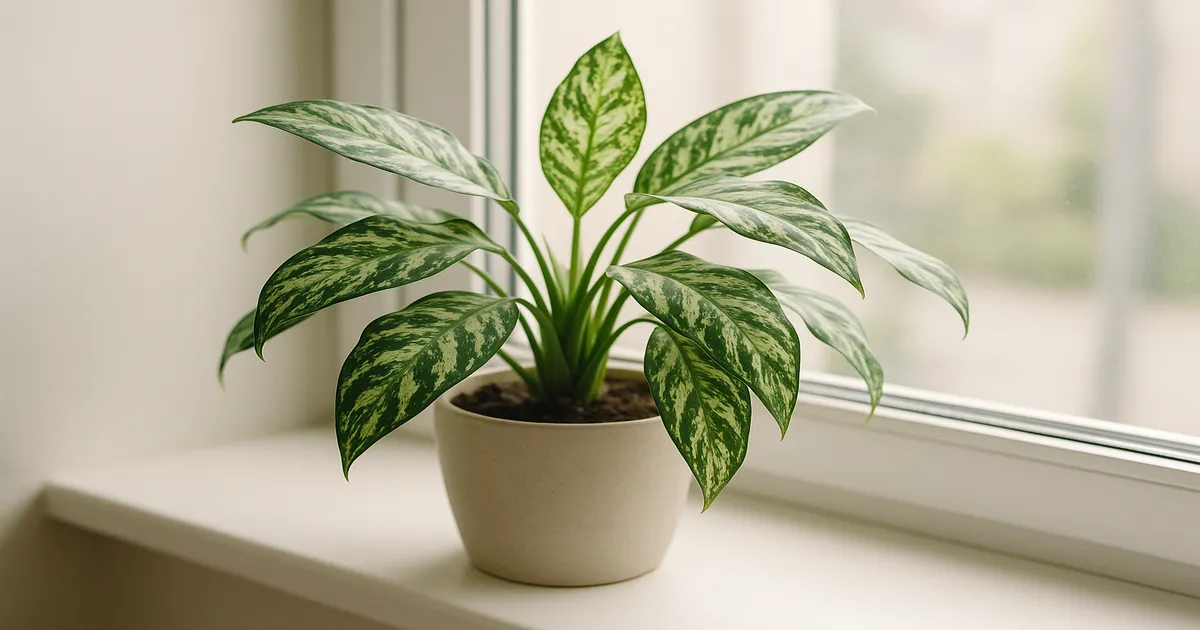
Quick Answer: A droopy Chinese evergreen has lost turgor pressure — the internal water pressure that keeps its cells firm and its stems upright. The most common culprits are overwatering and root rot, but underwatering, cold drafts, low humidity, pests, and repotting shock can all cause identical-looking wilting. Correct diagnosis before you act is everything: watering a root-rotted plant will make things worse, not better.
Common causes at a glance:
- Overwatering / root rot
- Underwatering / drought stress
- Too much or too little light
- Cold temperatures or drafts
- Root-bound pot
- Pest infestation
- Transplant shock after repotting
- Fertilizer salt buildup
- Low humidity
Why Is My Chinese Evergreen So Droopy? (How to Diagnose It)
Chinese evergreens stay upright through turgor pressure — the outward force that water-filled cells exert against their own walls. Think of it like a water balloon: full, it holds its shape; half-empty, it slumps. Aglaonema has fleshy, semi-succulent stems that store water, which makes the plant resilient but also sensitive to disruptions in water balance from either direction.
Here’s the frustrating part: a plant wilting from too much water looks almost identical to one wilting from too little. Both conditions prevent roots from delivering water to leaves and stems. This is why you must diagnose the cause before reaching for the watering can.
9 Reasons Your Chinese Evergreen Is Drooping
1. Overwatering and Root Rot (Most Common)
Excess water pushes oxygen out of the soil, suffocating roots and inviting opportunistic fungi — Pythium, Phytophthora, and Fusarium — that rot root tissue. The cruel irony: a plant with root rot can’t absorb water even when the soil is soaking wet, so it wilts just like a drought-stressed plant.
Signs to look for:
- Soil stays wet for more than 7–10 days
- Pot feels very heavy
- Yellowing leaves alongside drooping
- Fungus gnats hovering near the soil
- Mushy, dark, foul-smelling roots when unpotted
2. Underwatering and Drought Stress
When soil moisture drops too low, roots can’t maintain turgor pressure in leaf and stem cells. A hormone called abscisic acid (ABA) triggers stomatal closure to slow water loss, but if the deficit continues, cells begin to plasmolyze — the cytoplasm shrinks away from the cell wall — and the plant goes limp.
Signs to look for:
- Bone-dry soil pulling away from pot edges
- Pot feels very light when lifted
- Leaves feel thin, papery, or crispy at the tips
- Water runs straight through the soil without absorbing
3. Too Much or Too Little Light
Chinese evergreens evolved as forest understory plants. Too little light means insufficient photosynthesis to power normal cellular processes, so stems grow weak and etiolated. Too much direct sun causes rapid transpiration that the root system can’t keep up with, resulting in wilting and leaf scorch.
Signs to look for:
- Pale, washed-out leaves + drooping → too much light
- Leggy, stretched stems + drooping → too little light
- Brown, crispy patches on leaves → direct sun damage
Red and pink cultivars like ‘Red Siam’ need more light than green types like ‘Silver Bay’ or ‘Maria’, and they’re quicker to show stress when light is inadequate.
4. Cold Temperatures and Drafts
Aglaonema is a tropical genus with a hard minimum of around 60°F (15°C). Cold air from a drafty window, an AC vent, or an exterior door disrupts membrane function in plant cells, impairing their ability to transport water and nutrients. Below 50°F (10°C), cell membranes can be permanently damaged.
Signs to look for:
- Drooping concentrated on the side facing the cold source
- Dark, water-soaked patches on leaves
- Sudden wilting after a room change or cold snap
- Blackening at the base of stems
5. Root-Bound Pot
When roots have completely filled a pot and started circling the drainage holes, the small remaining volume of soil dries out within a day or two of watering. Severely compacted, circling roots also struggle to absorb water efficiently.
Signs to look for:
- Roots emerging from drainage holes or pushing up through the soil
- Plant dries out within 1–2 days of watering
- Stunted new growth despite good care
- Plastic pot visibly deformed by root pressure
6. Pest Infestation
Several common pests cause drooping by destroying root systems or draining the plant’s vascular fluids. Fungus gnat larvae feed on roots below the soil surface. Spider mites pierce leaf cells and extract their contents. Mealybugs and scale insects drain phloem sap, systematically weakening the plant over time.
Signs to look for:
- Fine webbing on leaves or between stems (spider mites)
- White cottony masses in leaf axils or on roots (mealybugs)
- Tiny flying insects near soil (fungus gnats)
- Sticky residue or sooty mold on leaves (sap-sucking insects)
- Stippled, bronzed, or distorted foliage
7. Transplant Shock After Repotting
Repotting always damages some roots, and that temporary disruption reduces the plant’s water-absorbing capacity. The plant droops while it regenerates new root tissue — usually for days to a few weeks. Using the wrong soil, jumping to a pot that’s too large, or repotting in winter all make the shock worse.
Signs to look for:
- Drooping begins within 24–72 hours of repotting
- No other obvious stressors present
- Plant otherwise looks healthy
8. Fertilizer Burn and Salt Toxicity
Excess fertilizer salts accumulate in the soil over time, raising its osmotic concentration. At a certain point, water actually moves out of root cells into the surrounding soil — the opposite of what should happen. The plant dehydrates from the roots outward, even when you’re watering regularly.
Signs to look for:
- White crusty deposits on the soil surface or pot rim
- Brown, crispy leaf tips and margins
- Drooping despite consistent watering
- Soil hasn’t been flushed in many months
9. Low Humidity
In the tropical forests where Aglaonema evolved, humidity rarely drops below 60–70%. In a heated or air-conditioned home — especially in winter — indoor humidity can fall below 30%, causing transpiration to outpace water uptake and leading to wilting.
Signs to look for:
- Drooping combined with brown, crispy leaf edges
- Symptoms worsen in winter or near heating vents
- Hygrometer reads below 40% RH
How to Diagnose Why Your Chinese Evergreen Is Drooping
Work through this checklist before you do anything else.
Step 1: Pick up the pot. A heavy pot almost always means overwatering. A surprisingly light pot points to underwatering. This one check rules out the two most common causes immediately.
Step 2: Do the finger test. Push your finger 1–2 inches into the soil. Wet and cold? Likely overwatered. Bone dry? Underwatered. Moist but not soggy? Water probably isn’t the issue.
Step 3: Inspect the roots. If you suspect overwatering, gently unpot the plant. Healthy roots are white or tan and firm. Rotted roots are brown or black, mushy, and smell unpleasant.
Step 4: Check for pests. Look under leaves for webbing, stippling, or cottony masses. Check the soil surface for tiny flying insects. Inspect stem bases and leaf axils for mealybugs or scale.
Step 5: Think about recent changes. Did you repot in the last few weeks? Move the plant? Fertilize recently? Experience a cold snap? Environmental changes are often the overlooked cause of sudden drooping.
Important: Do not water a drooping plant until you’ve completed this diagnosis. Watering a root-rotted plant accelerates the damage.
How to Fix a Droopy Chinese Evergreen
Overwatering: Treating Root Rot
- Unpot the plant and shake off as much old soil as possible.
- Prune all mushy, dark roots with sterile scissors — cut back to firm, healthy tissue.
- Dust cut surfaces with powdered cinnamon (a natural antifungal) or rinse roots with diluted hydrogen peroxide (3% H₂O₂ mixed 1:4 with water).
- Let roots air-dry for 30–60 minutes.
- Repot into fresh, well-draining mix in a pot with drainage holes. A peat- or coco coir-based mix amended with perlite works well — look for something labeled for indoor tropicals. (Fox Farm Happy Frog Potting Soil)
- Apply a biological fungicide containing Trichoderma or Bacillus subtilis to the new soil.
- Water sparingly for 2–4 weeks to encourage new root growth. Hold fertilizer until the plant shows clear recovery.
Underwatering: Rehydrating Properly
Place the pot in a basin of room-temperature water and let it soak for 30–45 minutes. Bottom-watering is especially effective if the soil has become hydrophobic. Follow up by top-watering until water drains freely from the bottom. If the soil still repels water, add a drop of diluted dish soap to act as a wetting agent.
Most plants bounce back within 12–24 hours of proper rehydration, as long as the drought wasn’t prolonged enough to cause serious root damage.
Light Problems
- Too little light: Move to a spot with medium to bright indirect light (1,000–2,500 foot-candles), or supplement with a full-spectrum LED grow light running 12–14 hours per day.
- Too much light: Move away from south- or west-facing windows, or filter direct sun with a sheer curtain.
Transition the plant gradually over 1–2 weeks to avoid adding stress on top of stress.
Cold Damage
Move the plant away from drafty windows, exterior doors, and AC or heating vents immediately. Keep temperatures between 65–80°F (18–27°C) and never let it drop below 60°F (15°C). Remove any severely cold-damaged leaves with clean scissors, reduce watering while the plant recovers, and hold off on fertilizer entirely.
Root-Bound Plant
Choose a new pot that’s only 1–2 inches larger in diameter than the current one — going too large invites root rot. Gently loosen and untangle any circling roots before placing in the new pot. Fill with fresh potting mix, water thoroughly, and keep the plant in a stable, warm spot out of direct sun for 1–2 weeks.
Pest Infestations
- Spider mites: Shower the plant to knock mites off, then spray with neem oil or insecticidal soap. Repeat every 5–7 days for 3–4 cycles. Raising humidity helps deter reinfestation.
- Mealybugs: Dab individual insects with a cotton swab dipped in 70% isopropyl alcohol, then follow up with neem oil spray. For root mealybugs, drench the soil with diluted neem oil.
- Fungus gnats: Let soil dry more between waterings — larvae need moisture to survive. Apply sticky yellow traps for adults and drench the soil with Bacillus thuringiensis israelensis (Bti) to kill larvae. Persistent infestations respond well to beneficial nematodes (Steinernema feltiae).
- Scale: Scrape off manually, then apply horticultural oil. Repeat applications are necessary since eggs are protected under the shells.
Transplant Shock
Don’t repot again — leave it alone. Place the plant in a warm, humid spot with medium indirect light (500–1,500 foot-candles) and keep the soil barely moist. Hold fertilizer for at least 4–6 weeks. A diluted seaweed extract drench can encourage faster root regeneration. Expect recovery to take 2–6 weeks depending on how much root damage occurred.
Fertilizer Salt Buildup
Scrape any white crusty deposits off the soil surface. Run room-temperature water slowly through the pot for 5–10 minutes, letting it drain completely, then repeat 2–3 times. Withhold fertilizer for 4–8 weeks. When you resume, use a balanced fertilizer at half the recommended dose.
Low Humidity
The most effective fix is a cool-mist humidifier placed near the plant. Grouping plants together also helps — their collective transpiration creates a localized humid microclimate. A pebble tray filled with water works as a low-tech option, as long as the pot sits above the waterline.
One thing that doesn’t work: misting leaves directly. It evaporates within minutes, doesn’t meaningfully raise ambient humidity, and can encourage fungal leaf spot.
Preventing a Droopy Chinese Evergreen: Ongoing Care
Watering
Water when the top 1–2 inches of soil are dry. A soil moisture meter takes the guesswork out of this — water when it reads 3–4 on a 1–10 scale. Always use room-temperature water; cold water can shock tropical roots. Filtered water, rainwater, or distilled water is preferable to tap water, since Chinese evergreens are sensitive to fluoride and chlorine, which cause tip burn over time. Never leave the pot sitting in standing water for more than 30 minutes.
Soil Mix
Chinese evergreens need a mix that drains well but still holds some moisture. A reliable DIY recipe: 60% peat-based or coco coir potting mix + 20% perlite + 20% orchid bark. This keeps roots aerated, prevents compaction, and gives you a wider margin for watering errors in either direction.
Light, Temperature, and Humidity Targets
| Parameter | Green Cultivars (‘Silver Bay’, ‘Maria’) | Red/Pink Cultivars (‘Red Siam’, ‘Creta’) |
|---|---|---|
| Light | Low–medium indirect (100–2,000 fc) | Medium–bright indirect (1,000–2,500 fc) |
| Water | Top 1–2 inches dry before watering | Top 1–2 inches dry before watering |
| Soil | 60% coco coir + 20% perlite + 20% orchid bark | Same |
| Temperature | 65–80°F; min 60°F | 65–80°F; min 65°F (more cold-sensitive) |
| Humidity | 50–70% RH; tolerates 40% | 50–70% RH; less tolerant of dry air |
| Fertilizer | Balanced 10-10-10 at half strength, spring–fall | Same |
| Repotting | Every 2–3 years, or when root-bound | Every 2–3 years, or when root-bound |
Fertilizing Without Causing Salt Buildup
Feed with a balanced, water-soluble fertilizer (10-10-10 or 20-20-20) at half the recommended strength during the growing season only (spring through early fall). Skip fertilizing in winter when growth naturally slows. Flush the soil with plain water every 2–3 months to prevent salt accumulation — this one habit prevents a surprising number of problems.
Frequently Asked Questions
Can a droopy Chinese evergreen recover?
Yes — in most cases, absolutely. The prognosis depends on how quickly you catch the problem and whether you treat the right cause. Underwatering recovers within 12–24 hours of proper rehydration. Transplant shock resolves in 2–6 weeks. Root rot is the trickiest, but even severely affected plants can recover if you remove all rotted tissue and repot promptly into fresh, well-draining soil.
How do I tell if my Chinese evergreen has root rot?
Unpot the plant and examine the roots directly. Healthy roots are white or tan and feel firm. Rotted roots are brown or black, feel mushy when squeezed, and often smell sour or foul. If you see a mix of healthy and rotted roots, the plant can still be saved — prune away all damaged tissue before repotting into fresh mix.
Should I water my Chinese evergreen if it is drooping?
Not until you’ve diagnosed the cause. If the soil is already wet and the pot feels heavy, adding more water will accelerate root rot and make recovery much harder. Only water if the soil is dry and the pot feels light.
How long does it take a droopy Chinese evergreen to recover?
It depends on the cause. Underwatering: 12–24 hours after proper rehydration. Cold or draft stress: a few days once moved to a warm spot. Transplant shock: 2–6 weeks. Root rot: several weeks to a few months, depending on how much root tissue was lost and how quickly you acted.
Why does my Chinese evergreen droop even after watering?
If the plant droops despite regular watering, root rot is the most likely culprit — damaged roots can’t absorb water even when it’s available. Other possibilities include fertilizer salt buildup (which pulls water out of roots osmotically), a severely root-bound pot, or pest damage to the root system. Unpot the plant and inspect the roots to confirm.