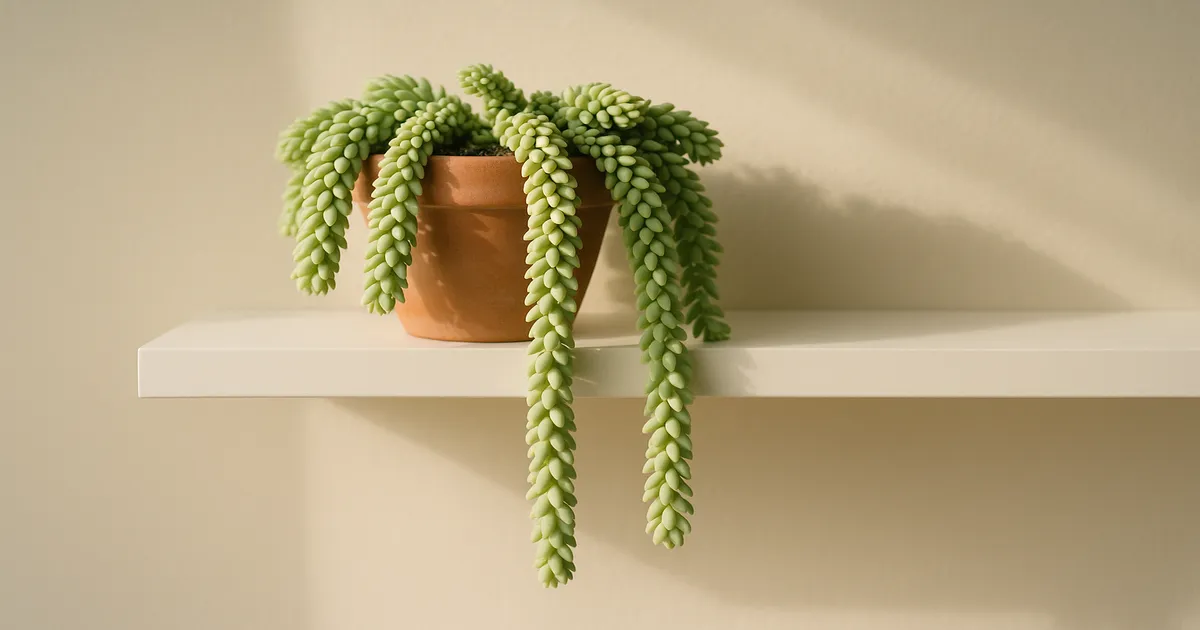
Quick Answer: Water burro’s tail every 10–14 days in spring, every 7–14 days in summer, every 14–21 days in fall, and just once every 3–6 weeks in winter. No fixed schedule beats checking the soil first — always let the top 1–2 inches dry out completely before reaching for the watering can.
Knowing how often to water burro’s tail (Sedum morganianum) is the single most important skill you’ll develop with this plant. Get it right, and those gorgeous trailing stems stay plump and blue-green for years. Get it wrong — usually by watering too often — and you’re looking at mushy leaves, root rot, and a plant in serious decline.
The good news: once you understand why burro’s tail behaves the way it does, the watering decisions almost make themselves.
How Often to Water Burro’s Tail: Seasonal Guide
Watering Frequency at a Glance
| Season | Typical Frequency | Soil Condition Before Watering |
|---|---|---|
| Spring | Every 10–14 days | Top 1–2 inches completely dry |
| Summer | Every 7–14 days | Completely dry throughout |
| Fall | Every 14–21 days | Completely dry throughout |
| Winter | Every 3–6 weeks | Bone dry for several days prior |
The Golden Rule: Soil Dryness Beats the Calendar
Treat the table above as a starting point, not a rigid rule. Two quick checks tell you more than any schedule:
- Finger test: Push your finger 1–2 inches into the soil. Feel any moisture at all? Wait a few more days.
- Chopstick method: Insert a wooden chopstick to the bottom of the pot, leave it 60 seconds, then pull it out. Soil particles clinging to the wood mean moisture is still present.
When in doubt, wait. Burro’s tail always handles a few extra dry days better than one extra watering.
Why Burro’s Tail Has Unique Watering Needs
Built-In Water Storage
Burro’s tail is native to rocky, arid hillsides in southern Mexico and Honduras — places where rain is unpredictable and soil drains fast. To survive, the plant evolved fat, teardrop-shaped leaves packed with specialized cells called hydrenchyma, which act like tiny internal water tanks. Those plump leaves aren’t just decorative; they’re the plant’s survival strategy.
This built-in reservoir is exactly why overwatering is so dangerous. The roots don’t need to stay moist to keep the plant hydrated — the leaves are already doing that job. Wet soil for extended periods starves roots of oxygen and invites rot.
CAM Photosynthesis: Why Dry Spells Don’t Hurt It
Burro’s tail uses a water-conserving process called CAM (Crassulacean Acid Metabolism). Most plants open their stomata — tiny leaf pores — during the day to absorb CO₂, losing water in the process. CAM plants flip the script: they open their stomata at night when it’s cooler, dramatically cutting moisture loss.
The practical takeaway is that this plant is genuinely built to handle dry spells. It doesn’t need frequent watering to stay healthy; it needs correct watering.
‘Burrito’ vs. Standard Species
The standard Sedum morganianum has longer, more pointed leaves with slightly higher water-storage capacity, making it marginally more drought-tolerant. The popular ‘Burrito’ cultivar has shorter, rounder leaves and is a touch more forgiving of irregular watering — a good choice if your routine isn’t perfectly consistent. Both follow the same general watering principles.
How to Tell If You’re Watering Correctly
Signs of a Healthy, Well-Watered Plant
A happy burro’s tail has firm, plump leaves with a consistent blue-green color and an intact powdery coating called farina. Stems hold their shape, and new growth appears at the tips during spring and summer. The leaves feel solid — almost like small grapes — when you gently touch them.
Overwatering Warning Signs
- Leaves feel mushy or look translucent
- Leaves fall off at the lightest touch
- Stem bases are turning black or brown
- Soil smells sour or sulfurous
- Leaves look swollen rather than plump and firm
Underwatering Warning Signs
- Leaves look wrinkled, shriveled, or deflated
- Leaves feel thin and papery
- Color appears dull or matte instead of vibrant blue-green
- Older leaves near the base are dropping first
Leaf Texture: The Key Diagnostic
Both overwatering and underwatering cause leaf drop, which confuses a lot of growers. Texture is your diagnostic tool. Mushy or translucent = too much water. Shriveled or papery = too little. Check the texture before you do anything else.
Common Watering Mistakes and How to Fix Them
Overwatering: The Number One Killer
When soil stays wet too long, the root zone becomes anaerobic — oxygen-depleted. Roots begin to die, and water-mold pathogens like Pythium and Phytophthora move in fast. Once root rot takes hold, the plant can’t absorb water or nutrients even if you correct everything else. Damage compounds quietly until symptoms become obvious.
How to rescue an overwatered burro’s tail:
- Stop watering immediately and move the plant to bright indirect light (1,500–3,000 foot-candles) with good airflow.
- Unpot the plant and gently shake off all the old soil.
- Inspect the roots. Healthy roots are white to tan and firm. Cut away anything black, mushy, or foul-smelling with sterile scissors.
- Optionally, apply a copper- or sulfur-based fungicide, or a biological product containing Bacillus subtilis, to address remaining pathogen activity.
- Air-dry the roots for 24–48 hours before repotting.
- Repot into fresh, dry succulent mix in a clean pot with drainage holes.
- Wait 5–7 days before watering lightly — this gives root wounds time to callous.
Underwatering: When Drought Stress Goes Too Far
When the hydrenchyma cells run dry, the plant starts pulling water from its oldest leaves to protect new growth at the tips. Those lower leaves shrivel and drop first. Prolonged drought can also impair the CAM photosynthesis cycle, weakening the plant even after you resume watering.
How to revive an underwatered burro’s tail: Use the soak-and-drain method — water slowly and thoroughly until water flows freely from the drainage holes, then let it drain completely. Never let the pot sit in standing water. Increase your watering frequency slightly for two to three weeks, then reassess based on soil dryness. Severely shriveled leaves rarely recover their original plumpness, so focus on new growth as your sign the plant is bouncing back.
Pot, Soil, and Drainage: The Hidden Watering Variables
Pot Size and Material
An oversized pot is a silent overwatering trap. Roots absorb moisture from their immediate zone, but surrounding soil stays wet for days — creating the same anaerobic conditions as watering too often, even when your schedule is perfect. Choose a pot only 1–2 inches wider in diameter than the root ball.
Terracotta or unglazed ceramic pots are the best choice for burro’s tail. Their porous walls allow moisture to evaporate from the sides, drying the soil 30–50% faster than plastic or glazed ceramic. A terracotta pot like the Pennington Classic Terracotta Clay Pot gives you a much wider margin for error.
The Best Soil Mix
Skip standard potting mix entirely — it holds far too much water. The ideal DIY blend is:
- 50% coarse inorganic material: perlite, pumice, or horticultural grit (2–4mm particle size)
- 50% organic base: cactus/succulent potting mix
For the inorganic portion, Espoma Organic Perlite is a reliable, widely available option. Pair it with Hoffman Organic Cactus and Succulent Soil Mix for the organic base. This blend should drain within seconds of watering and dry out completely within one to three days indoors. Target a soil pH of 6.0–7.0. Avoid mixes containing water-retaining crystals, high peat content, or vermiculite as a primary amendment.
Drainage Holes Are Non-Negotiable
No drainage hole means water pools at the bottom and wicks back up into the root zone. There’s no workaround — no gravel layer, no careful watering technique compensates for a sealed pot. If you love a decorative cachepot, use it as a sleeve around a proper nursery pot, and always empty it after watering.
When to Repot
If water runs straight through almost immediately, or roots are poking out of the drainage holes, it’s time to repot. Do it in spring, moving up just 1–2 inches in pot diameter. Handle the plant gently — those leaves detach at the slightest bump — and wait 7–10 days after repotting before watering.
Seasonal Watering Adjustments
Spring and Summer: Active Growth
As day length increases in spring and new growth appears at the stem tips, gradually increase your watering frequency from the winter schedule. By summer, most burro’s tails are ready for water every 7–14 days, though plants near a south-facing window or heat source may dry out faster. Always confirm with the finger test before watering.
Fall: Tapering Off
Starting in September or October (Northern Hemisphere), stretch your intervals to every 14–21 days. The plant is winding down, its metabolism is slowing, and it needs less water to sustain itself. Ease off gradually rather than switching to winter mode overnight.
Winter: The Most Dangerous Season for Overwatering
Winter is when most burro’s tails die from overwatering. Lower light, cooler temperatures, and a significantly slower metabolism mean the plant may only need water every 3–6 weeks. The soil should be bone dry for several days before you water at all. If you’re keeping the plant at 50–60°F (10–15°C) during winter — which encourages healthy dormancy — it needs even less.
How Environment Shifts the Equation
A plant near a heat vent or south-facing window can dry out twice as fast as one in a dimmer spot. Humidity above 70% slows soil drying and raises fungal risk; humidity below 30% speeds drying and can cause mild leaf shriveling even with regular watering. A probe-style moisture meter like the XLUX Soil Moisture Meter removes the guesswork — water only when the reading drops to 1–2 on a 1–10 scale, measured at the bottom of the pot.
Water Quality and Long-Term Health
Hard Water, Chlorine, and Fluoride
Over time, fluoride and chlorine accumulate in the soil and can disrupt plant enzyme activity. Hard water (high in calcium and magnesium carbonates) pushes soil pH above 7.5, locking out micronutrients like iron and manganese. The visible signs are brown leaf tips, white crusty deposits on the pot rim or soil surface, and yellowing between leaf veins (interveinal chlorosis).
Best Water Options
Filtered water, rainwater, and distilled water are all excellent choices. If you’re using tap water, let it sit uncovered for 24 hours to off-gas chlorine — though this won’t remove fluoride or dissolved minerals. If your tap water is alkaline (above pH 7.0), add a few drops of food-grade citric acid or white vinegar and check with a pH meter or test strips until you reach the 6.0–6.5 range.
Flushing Mineral Salts
Every three to four months, flush the soil by watering heavily two or three times in succession, letting it drain fully between each pass. This leaches accumulated mineral salts out through the drainage holes before they reach harmful levels — a simple habit with a real long-term payoff.
Fertilising Without Disrupting Your Watering Routine
Feed once a month in spring and summer only, using a low-nitrogen liquid fertilizer with an NPK ratio like 2-7-7 or 5-10-10, diluted to 25–50% of the label strength. Schultz Cactus Plus Liquid Plant Food is a good fit for this purpose. Always water the plant before fertilizing — applying fertilizer to dry roots causes burn. Skip fertilizing entirely in fall and winter; it stimulates growth the plant can’t support in low-light conditions.
Frequently Asked Questions About Watering Burro’s Tail
How do I know if my burro’s tail needs water?
Check the soil 1–2 inches down with your finger or a chopstick — if you detect any moisture, wait. Also look at the leaves: slightly less plump or a bit dull in color means the plant is ready for water. Firm, vibrant leaves with intact farina mean it still has reserves.
Can burro’s tail recover from overwatering?
Yes, if you catch it early. Remove the plant from its pot, cut away rotten roots, let it air-dry for 24–48 hours, and repot in fresh dry succulent mix. Wait 5–7 days before watering again. Plants caught at the mushy-leaf stage usually pull through; those with fully blackened stems may not.
Why are my burro’s tail leaves falling off when I touch them?
Leaf drop at a touch is almost always overwatering. When roots rot and can no longer support the plant, leaves become waterlogged and detach easily. Check the stem bases for blackening and the soil for a sour smell. Underwatering can also cause leaf drop, but those leaves will feel shriveled and papery rather than soft and mushy.
Should I water burro’s tail differently in winter?
Absolutely. In winter, water only every 3–6 weeks — or whenever the soil has been completely dry for several days. Lower light, cooler temperatures, and the plant’s semi-dormant state mean it uses very little water. Keeping a summer watering schedule through winter is one of the most common ways to kill this plant.
What is the best soil mix to prevent overwatering?
Combine 50% coarse inorganic material (perlite, pumice, or horticultural grit) with 50% cactus/succulent potting mix. This blend drains almost instantly and dries out completely within one to three days, making it much harder to accidentally overwater. Avoid any mix containing water-retaining crystals, high peat content, or vermiculite.