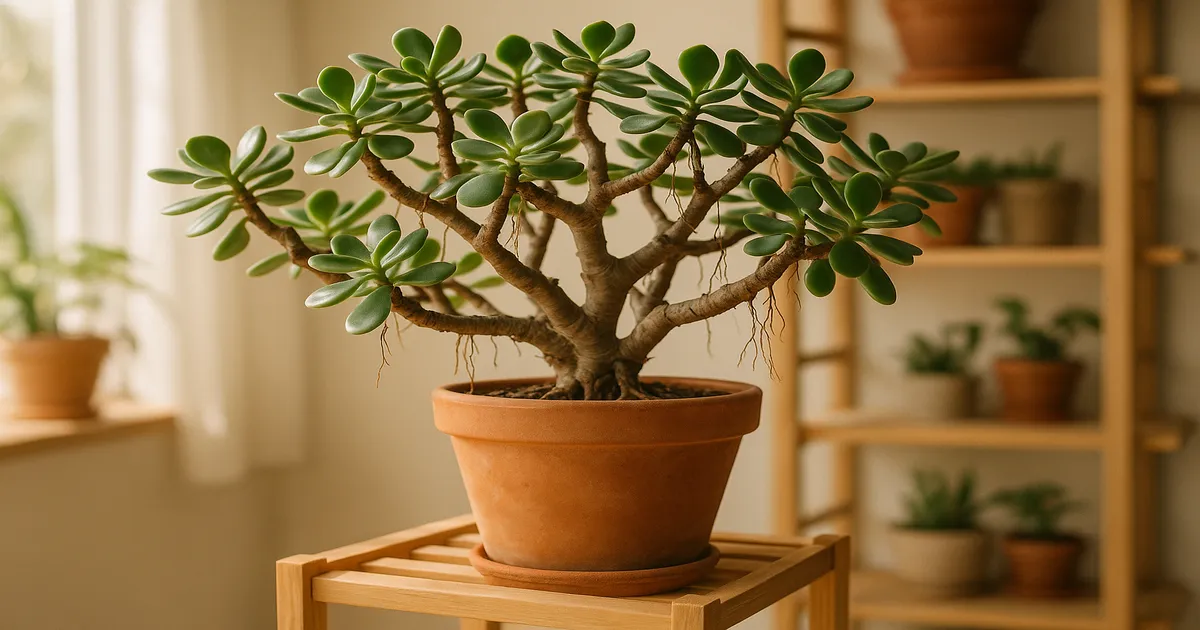
Quick Answer: Those unexpected growths on your jade plant (Crassula ovata) are almost always one of ten things: aerial roots, offsets, flower buds, corky callus, pest colonies, fungal or bacterial growth, mineral deposits, edema blisters, etiolation, or normal new growth. Most are harmless — a few need prompt action. Read on to identify exactly what you’re looking at and what to do about it.
What Is This Growing From My Jade Plant? The 10 Most Common Causes
If you’ve ever caught yourself Googling “what is this growing from my jade plant?” you’re in good company. Jade plants are long-lived, woody succulents — sometimes surviving 70 to 100 years in cultivation — and they produce a surprisingly wide range of structures as they mature. Their smooth bark and fleshy leaves make anything unusual very easy to spot.
| Growth | What It Looks Like | Urgency |
|---|---|---|
| Aerial roots | Reddish-brown cords from stems | Normal |
| Offsets / pups | Mini jade plants at the base | Normal |
| Flower buds | Tiny star-shaped clusters at tips | Normal |
| New leaf/branch growth | Shiny green nubs at nodes | Normal |
| Stem corking | Tan, rough bark-like patches | Normal |
| Mealybugs | White cottony masses in leaf axils | Act now |
| Scale insects | Hard brown bumps on stems | Act now |
| Spider mites | Tiny specks + fine webbing | Act now |
| Edema | Corky blisters on leaf surfaces | Monitor |
| Etiolation | Long, pale, spindly stems | Monitor |
| Mineral deposits | White chalky crust on soil/stems | Monitor |
| Fungal/bacterial growth | Mold, rot, or collapsing tissue | Act now |
Start with the section that best matches what you see — normal growths, pests, stress responses, or disease. Each section explains what the growth is, what caused it, and exactly what to do.
Normal Growths: What Healthy Jade Plants Naturally Produce
Aerial Roots
Aerial roots are thin, reddish-brown to tan, cord-like projections that emerge directly from the stem, usually at nodes. They’re adventitious roots — meaning they form from stem tissue rather than the root system — and they’re completely normal. In the wild, jade stems that fall to the ground root readily. Indoors, they appear when the plant senses high humidity or experiences mild stress.
Common triggers include humidity above 60–70%, overwatering, low light, or minor stem damage. None of these are emergencies on their own, though it’s worth checking whether overwatering is the culprit.
Offsets and Basal Pups
Small jade plants sprouting from the soil surface or lower trunk are offsets — a form of vegetative reproduction. They emerge from meristematic tissue at or below the soil line and become more common as the plant matures. Repotting disturbance, drought stress, or damage to the main growing tip can all trigger a flush of new pups.
Flower Buds
Jade plants need shorter days (fewer than about 12 hours of light) combined with cool nights around 10–13°C (50–55°F) to trigger blooming. The pale, waxy buds appear at branch tips in late autumn or winter and open into small, star-shaped pink or white flowers. Indoor plants rarely bloom because artificial lighting disrupts the photoperiod signal. If yours does flower, it’s a sign of a happy, mature plant.
New Leaf and Branch Growth
Shiny green nubs appearing at branch tips or nodes after pruning are exactly what you want to see. Removing a growing tip disrupts apical dominance — the hormonal suppression that keeps lateral buds dormant — and multiple new shoots emerge in response. Spring is the most active growth period, when rising temperatures and longer days kick the plant back into gear.
Stem Corking
As jade plants age, their lower stems develop a rough, tan, bark-like coating called suberization. The plant deposits suberin (a waxy polymer) into cell walls to form protective cork tissue — the same biological process that creates bark on trees. Pruning cuts, sunburn, or minor pest damage can accelerate it locally. Healthy callus is always dry, firm, and uniform in color.
Pest Infestations: When the “Growth” Is Actually Insects
Mealybugs
Mealybugs (Pseudococcidae) are oval, 2–4 mm insects covered in white waxy filaments that give them a fluffy, cottony appearance. They cluster in leaf axils, along stems, and sometimes at the soil line. As they feed on phloem sap, they excrete honeydew — a sticky sugar solution that becomes a growth medium for sooty mold fungus.
Scale Insects
Scale insects are the growth most commonly mistaken for something natural. Their protective coverings are hard, dome-shaped or flat, and range from tan to dark brown — convincingly bark-like. They attach firmly to stems and leaves and don’t move once settled. If you scrape one off and it comes away in one piece leaving a pale mark underneath, it’s scale, not callus.
Spider Mites
Spider mites (Tetranychidae) are barely visible to the naked eye — less than 1 mm — but their damage is unmistakable: stippled, silvery leaf surfaces and fine webbing between leaves and stems. They thrive when humidity drops below 40% RH, making heated winter homes the perfect environment. Always check leaf undersides first.
How to Tell Pests Apart From Natural Plant Structures
- Scrape test: Natural callus is firmly integrated into stem tissue. Pest colonies and scale lift away cleanly.
- Symmetry: Corking follows the stem’s natural aging pattern. Pest clusters appear randomly, often in sheltered spots like leaf axils.
- Movement: Use a magnifying glass. Any movement means insects.
- Stickiness: Honeydew from mealybugs or soft scale makes nearby leaves feel tacky. Mineral deposits and callus do not.
Stress Responses: Growths Caused by Environmental Problems
Edema
Edema looks alarming — raised, corky, blister-like bumps on leaf surfaces or undersides, sometimes resembling insect eggs. It’s actually a hydraulic disorder: when roots absorb water faster than leaves can transpire it, mesophyll cells rupture, and the plant forms corky repair tissue over the damage. It’s not contagious and not caused by any pathogen.
The fix is straightforward: let the soil dry out more between waterings, improve light levels, and ensure good air circulation. Existing blisters won’t disappear, but new ones will stop forming.
Etiolation
Etiolation happens when a jade plant doesn’t get enough light. Stems elongate dramatically between leaf nodes while the leaves stay small and pale. It’s driven by phytochrome signaling: a low red-to-far-red light ratio triggers a shade-avoidance response that prioritizes height over density.
Jade plants need at minimum 1,000–1,500 foot-candles to stay compact, and they really thrive at 2,000–5,000+ foot-candles. A south- or east-facing window is ideal. Etiolated growth won’t reverse, but pruning it back and moving the plant to a brighter spot will encourage compact new growth.
Mineral Salt Crusts
White crystalline crust on the soil surface, on terracotta pots, or creeping up lower stems is mineral efflorescence — calcium carbonate, magnesium sulfate, and other salts left behind as water evaporates. Over time, fertilizer salt accumulation raises soil electrical conductivity and can cause brown leaf tips and root damage. Flush the soil thoroughly with distilled or filtered water every two to three months to leach accumulated salts.
Fungal and Bacterial Growths: When to Worry
Root Rot
White, thread-like mycelium at the soil line or around the stem base is a serious warning sign. Root rot — caused by Pythium, Phytophthora, or Fusarium species — is almost always the result of overwatering in poorly draining soil. Below the surface, roots will be black, mushy, and foul-smelling. Act immediately; a plant with advanced root rot can collapse within days.
Powdery Mildew
Powdery mildew (Erysiphe spp.) forms a white, dusty coating on leaf surfaces that doesn’t wipe off cleanly — unlike sooty mold. It thrives in moderate humidity (50–70% RH) with poor air movement. Improve ventilation first, then treat with a baking soda spray (1 tsp baking soda + 1 tsp dish soap per quart of water) or a copper-based fungicide.
Sooty Mold
Sooty mold is a secondary problem — it grows on honeydew excreted by mealybugs or soft scale, not on plant tissue itself. The black coating wipes off easily with a damp cloth. Treat the underlying pest infestation and the mold resolves on its own once the food source is gone.
Bacterial Soft Rot
Bacterial soft rot (Erwinia spp.) is the most urgent scenario you’ll encounter. Affected stem sections look water-soaked and translucent, then collapse into foul-smelling mush. It spreads rapidly in warm, wet conditions. Remove all affected tissue immediately with sterile tools, cutting well into healthy growth, and allow the plant to dry out completely before any further watering.
How to Treat Every Type of Jade Plant Growth
Aerial Roots
Snip them off with clean scissors if they bother you aesthetically — no harm done. Alternatively, press the aerial root into a moist mix of perlite and coarse sand to propagate a new plant. If overwatering triggered them, let the soil dry completely between waterings going forward.
Separating and Potting Offsets
- Separate the offset from the mother plant with a clean knife, keeping some root tissue attached.
- Let the cut surface air-dry for 24–48 hours.
- Plant in a well-draining mix: 50% inorganic material (perlite or pumice) and 50% organic material (coco coir or quality potting mix), targeting pH 6.0–7.0. A pre-blended succulent mix works well here.
- Wait one week before watering lightly.
Eliminating Mealybugs
- Isolate the plant immediately.
- Dab individual colonies with a cotton swab soaked in 70% isopropyl alcohol.
- Spray the entire plant with insecticidal soap (2–3 tsp per quart of water) or a 2% neem oil emulsion.
- Repeat every 7–10 days for at least 3–4 cycles to break the egg cycle.
- For severe infestations, apply a systemic imidacloprid soil drench — but avoid this if the plant is in bloom.
- Unpot and inspect roots for root mealybugs (Rhizoecus spp.); if found, wash roots clean, treat with an insecticidal soap drench, and repot in fresh sterile mix.
Getting Rid of Scale Insects
- Scrape off individual scales with a soft toothbrush or wooden skewer.
- Apply 70% isopropyl alcohol directly to any remaining scales.
- Follow with a horticultural oil spray at 2–3% dilution to smother crawlers.
- Repeat every 10–14 days — scale is persistent and requires multiple treatments.
Controlling Spider Mites
- Raise humidity to 50–60% RH; mites struggle to reproduce above 60%.
- Blast leaves with water (outdoors or in a shower) to dislodge mites physically.
- Apply insecticidal soap or neem oil, focusing on leaf undersides.
- For severe infestations, use a miticide containing abamectin or bifenazate, rotating active ingredients to prevent resistance.
Rescuing a Jade Plant With Root Rot
- Unpot immediately and trim all black, mushy roots with sterile scissors.
- Dust cut surfaces with powdered sulfur or a copper-based fungicide.
- Air-dry the plant for 24–72 hours before repotting.
- Use completely fresh, sterile succulent mix — never reuse contaminated soil.
- Choose a terracotta pot with drainage holes; the porous walls wick away excess moisture and reduce the risk of repeat rot.
- Hold off watering for 1–2 weeks to let root wounds heal.
Fixing Edema, Etiolation, and Salt Buildup
Edema: Reduce watering frequency, improve light, and increase air circulation. Existing blisters are permanent, but new ones will stop forming once conditions improve.
Etiolation: Prune back leggy stems and move the plant to a brighter location — a south- or east-facing window is ideal. If natural light is limited, a full-spectrum grow light placed 6–12 inches above the plant works well. Acclimate gradually over 2–4 weeks to avoid sunburn.
Salt buildup: Flush the soil thoroughly with distilled or filtered water until it runs freely from the drainage holes. Repeat every 2–3 months and scrape visible crust from the soil surface before flushing.
Prevention: Keeping Unusual Growths to a Minimum
Water correctly. Use the soak-and-dry method: water thoroughly until it drains from the bottom, then wait until the top 2 inches of soil are completely dry before watering again. This prevents root rot, edema, and the soggy conditions that attract mealybugs and fungal pathogens.
Provide enough light. Bright indirect light (1,500–3,000 foot-candles) is the minimum for healthy, compact growth. Direct morning sun (3,000–5,000+ foot-candles) is even better. Insufficient light is the root cause of etiolation and increases susceptibility to pests and edema.
Choose the right pot and soil. Always use a pot with drainage holes. Terracotta is the best choice because it wicks excess moisture through its walls. Use a mix of 50% inorganic material (perlite or pumice) and 50% organic material, targeting a pH of 6.0–7.0.
Manage humidity. Jade plants prefer 40–60% relative humidity. Below 40%, spider mites thrive; above 70%, you risk edema and fungal issues. A small fan near the plant improves air circulation and dramatically reduces powdery mildew risk.
Inspect monthly. Take two minutes each month to check leaf axils, stem crevices, and the soil surface. Flip a few leaves and look at the undersides for mites or scale crawlers. Early detection means a cotton swab and alcohol can solve the problem before it requires a systemic treatment.
Frequently Asked Questions: What Is This Growing From My Jade Plant?
Why is my jade plant growing roots out of its stem?
Those are aerial roots — adventitious roots that form from stem tissue rather than the root system. They’re triggered by high humidity, overwatering, low light, or minor stem damage. They’re harmless and can be pruned off, left alone, or used to propagate a new plant by pressing them into moist growing medium.
What are the white fluffy spots on my jade plant?
White fluffy or cottony masses are almost certainly mealybugs. Dab each colony with a cotton swab soaked in 70% isopropyl alcohol, then spray the whole plant with insecticidal soap or neem oil. Repeat every 7–10 days for a month to break the egg cycle.
Why does my jade plant have hard brown bumps on its stems?
Hard, dome-shaped brown bumps that don’t scrape off easily are likely scale insects. If they lift away cleanly and leave a pale mark, they’re definitely scale — not natural corking. Treat with isopropyl alcohol followed by horticultural oil, repeating every 10–14 days.
What are the corky blisters on my jade plant’s leaves?
Corky blisters are edema — a hydraulic disorder caused by overwatering combined with low light or poor air circulation. The plant absorbs water faster than it can transpire it, cells rupture, and corky scar tissue forms. Existing blisters are permanent, but reducing watering and improving light will stop new ones from forming.
My jade plant has white powder on its leaves. What is it?
A white, dusty coating that doesn’t wipe off cleanly is powdery mildew. Improve air circulation around the plant first, then treat with a baking soda spray (1 tsp baking soda + 1 tsp dish soap per quart of water) or a copper-based fungicide. If the white coating wipes off easily and the leaves below it feel sticky, it’s sooty mold from a mealybug or scale infestation — treat the insects and the mold will clear up on its own.