Quick Answer: Buying houseplants is addictive because it simultaneously triggers your brain’s dopamine reward system, satisfies a deep evolutionary drive to connect with living things, activates caregiving instincts, and delivers genuine mental health benefits — all wrapped inside a hobby with no natural finish line. It’s not a personal weakness; it’s multiple overlapping psychological systems firing at once, which is exactly why the global houseplant market hit $19.6 billion in 2023.
If you’ve ever told yourself “just one more plant” and genuinely meant it, you already understand why buying houseplants is so addictive. What you might not realize is how many separate brain systems are conspiring against your credit card at any given moment. This isn’t about willpower. The hobby is, quite literally, shaped by evolution, neuroscience, and a plant kingdom containing 390,000 species — all working together to keep you coming back for more.
The Dopamine Loop: How Plant Shopping Hijacks Your Brain
Why Anticipation — Not Ownership — Is the Real Hook
Here’s the counterintuitive truth about dopamine: it spikes hardest before you get what you want, not after. Neuroscientist Wolfram Schultz’s landmark 1997 research on reward prediction error showed that the brain’s mesolimbic dopamine pathway surges during anticipation of a reward. Browsing a plant shop, scrolling Instagram plant accounts at midnight, tracking a delivery — that’s where the real neurological hit lives.
The moment the plant arrives? Dopamine normalizes. Which is partly why the next browsing session starts so soon.
The Slot Machine Effect
Plant growth is unpredictable. A cutting might root in two weeks or two months. A new leaf might unfurl perfectly or arrive slightly deformed. This unpredictability creates what behavioral psychologists call a variable reward schedule — the same reinforcement pattern that makes slot machines so hard to walk away from. Your brain can’t habituate to a reward it can’t predict, so it keeps paying attention.
When a plant exceeds expectations — a dramatic new leaf, faster-than-expected roots — dopamine surges above baseline. When a plant dies, the system recalibrates and drives renewed seeking behavior. Plant death, paradoxically, often leads straight to purchasing a replacement. The loop is self-sealing.
Biophilia: Why Buying Houseplants Is So Addictive at an Evolutionary Level
E.O. Wilson’s Biophilia Hypothesis
In 1984, biologist E.O. Wilson proposed the biophilia hypothesis: humans have an innate, evolutionarily-rooted drive to seek connection with other living systems. Our ancestors’ survival depended on reading landscapes, tracking plant life, and staying attuned to the natural world. That wiring doesn’t disappear because we live in apartments.
The research backs Wilson up. Neuroimaging studies show that exposure to plants and natural scenes reduces activity in the subgenual prefrontal cortex — a region associated with rumination — and lowers cortisol levels by roughly 10–15%. That’s not poetic; it’s physiology.
Why Urban Living Amplifies the Urge to Collect
The biophilic need is chronic, not episodic. A single pothos on a desk rarely satisfies it, especially when your daily environment is concrete, screens, and artificial light. Each new plant partially scratches the itch — and then the itch returns. The more nature-deprived your environment, the stronger the pull toward filling it with living things. Urban living doesn’t create the urge; it amplifies one that was already there.
The Collector’s Trap: Scarcity, Status, and the Impossible Finish Line
The 390,000-Species Problem
Psychologist Russell Belk’s research on collecting behavior identifies three core drives: completeness, mastery, and identity expression. The plant kingdom is a collector’s perfect trap because completeness is structurally impossible. There are over 390,000 described plant species, thousands suitable for indoor cultivation. Decide you want every Philodendron species? There are 500+. Congratulations — you now have a lifetime project.
How Rare Cultivars Exploit Scarcity Psychology
Variegated cultivars like Monstera deliciosa ‘Thai Constellation’ and Philodendron ‘Pink Princess’ result from chimeric cell mutations — sectors of cells that lack chlorophyll — which means every single specimen looks different. You can’t own “the” Thai Constellation; you can only own your Thai Constellation. That uniqueness, combined with genuine scarcity for plants like Monstera albo variegata or Philodendron spiritus-sancti, triggers the scarcity heuristic: we value things more when they’re hard to get.
New cultivars are released continuously. The “complete collection” is a permanently moving target — and that’s not a bug in the hobby. It’s the feature that keeps collectors engaged indefinitely.
FOMO and Limited Plant Drops
Within plant communities, rare plants signal knowledge, taste, and commitment. Kahneman and Tversky’s Prospect Theory explains the rest: “last one in stock” banners and limited seasonal drops exploit loss aversion, making inaction feel more costly than spending. The fear of missing out on a plant drop is neurologically identical to the fear of losing something you already own.
Nurturing, Community, and Identity: The Social Side of Why Houseplant Buying Is So Addictive
Why Caring for Plants Activates Caregiving Circuits
Humans have dedicated neural circuits for caregiving — wired for offspring, but readily generalized. Watching a new leaf emerge, nursing a sick plant back to health, or successfully rooting a cutting activates the ventral tegmental area (VTA) and releases both dopamine and oxytocin, the bonding hormone. Because plants respond slowly, the anticipation-reward cycle stretches over days or weeks, prolonging neurological engagement rather than shortening it.
Many plant owners name their plants and attribute personalities to them. This isn’t silly — it’s anthropomorphization, and it deepens emotional investment significantly. It also means losing a plant carries genuine emotional weight, sometimes enough to trigger immediate replacement purchasing.
How Online Plant Communities Reinforce Buying
The social ecosystem around houseplants is enormous. Reddit’s r/houseplants has over 3 million members. Instagram plant accounts and TikTok “plant tours” generate millions of views. These communities provide social validation, aspirational content, and constant exposure to plants you don’t yet own.
Social identity theory (Tajfel & Turner, 1979) explains the deeper mechanism: being a “plant person” becomes a core part of your self-concept, and purchasing reinforces that identity. Every new plant is also a piece of content. Content generates social capital — likes, comments, followers — which rewards the buying behavior all over again.
Plant swapping adds yet another layer. Receiving a cutting from a friend’s prized Hoya creates emotional value that no retail purchase can replicate. Propagating and trading builds reciprocal social bonds, and those bonds motivate growing your collection further — not out of compulsion, but out of genuine community participation.
The Therapeutic Loop: Real Benefits That Keep You Buying More
Horticultural therapy is a recognized clinical field with documented outcomes: measurable reductions in anxiety and depression symptoms, improved mood, and an enhanced sense of purpose. The benefits are real enough that plant care is used in hospitals, rehabilitation centers, and mental health programs.
For people navigating anxiety or high-stress lives, plant care provides something genuinely valuable: a sense of control over a living system, measurable evidence of competence (that new leaf is proof you did something right), and a routine that anchors the day. Watering, pruning, and inspecting plants requires present-moment attention — it’s structured mindfulness that doesn’t require a meditation app.
Here’s the paradox: because plants genuinely improve wellbeing, the logical conclusion is that more plants would improve it further. That reasoning isn’t entirely wrong — but it does create a therapeutic dependency loop that’s easy to rationalize. The hobby also has progressive difficulty built in. Easy to start with a pothos; nearly impossible to fully master a Nepenthes rajah. Every species mastered motivates attempting the next challenge, and the skill ceiling never arrives.
How to Collect Mindfully
The goal isn’t to stop — it’s to channel the behavior so it stays pleasurable rather than stressful.
Use a wish list and waiting period. Keep a running list of plants you want and impose a 7–14 day waiting period before buying anything on it. This preserves the anticipation phase (which is neurologically the most rewarding part anyway) while eliminating the regret that follows impulse purchases. Pair it with a monthly plant budget treated like any other discretionary spending category.
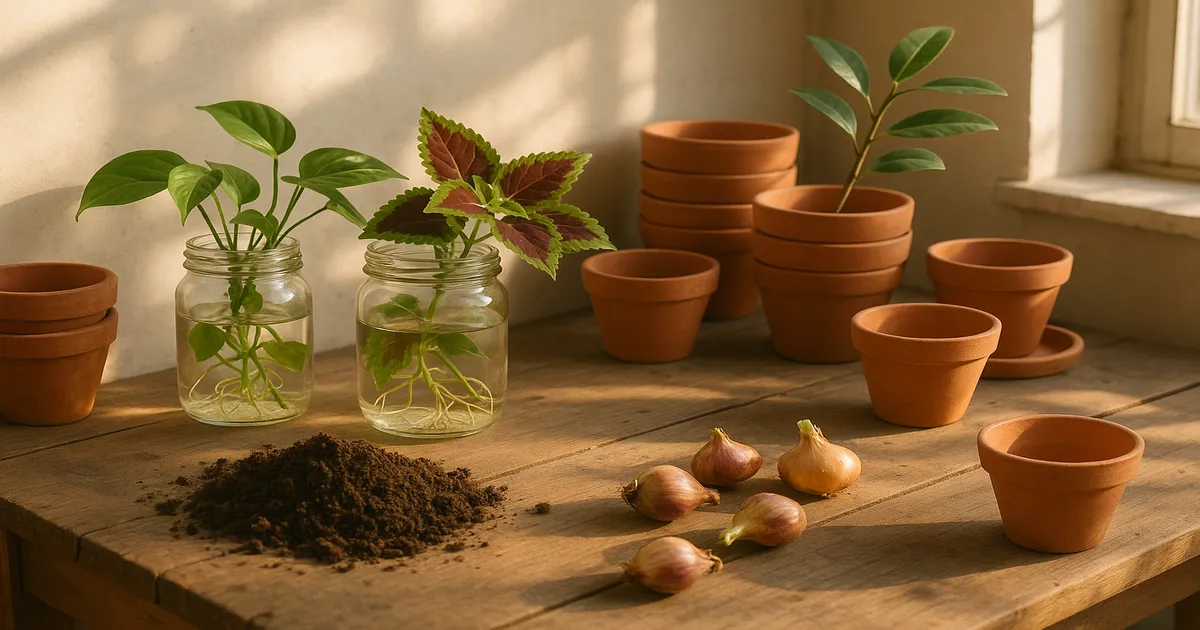
Redirect acquisition energy into propagation. Propagation delivers the same novelty and reward cycle as buying — without the spend. A dedicated propagation station stocked with perlite and sphagnum moss gives you a free acquisition engine that also deepens your skills. Rooting a cutting from a friend’s plant is often more satisfying than buying the same plant retail.
Define a collection focus. Unfocused accumulation never feels complete because there’s no finish line. Choosing a genus or aesthetic theme — only Hoya species, only Southeast Asian tropicals, only variegated aroids — creates an achievable sense of mastery and makes each addition feel purposeful.
Curate your social media. If plant Instagram is triggering purchases you later regret, shift your feed toward educational content — care guides, propagation techniques, botanical science — rather than aspirational collection tours. Plant swaps are worth seeking out too: they satisfy acquisition desire, build community, and typically cost nothing beyond propagation effort.
Building a Collection Your Space and Skills Can Support
Check your light before buying demanding species. A light meter app will tell you whether your shelf actually delivers the bright indirect light most aroids need (1,500–3,000 foot-candles) or just the dim ambient light (under 200 foot-candles) that only a Sansevieria will tolerate. For a reliable reading, a dedicated meter beats a phone app.
Know your humidity. A basic hygrometer (under $15) will tell you your home’s average relative humidity. Most homes sit at 30–50% RH — fine for pothos and snake plants, but genuinely insufficient for Calathea (which prefer 60–80% RH) or Nepenthes (70–90% RH). Buying a demanding species without checking is how collections accumulate casualties.
Test your water if you grow fussy plants. Carnivorous plants and Calathea need water under 50 ppm total dissolved solids (TDS); most municipal tap water runs well above that. A TDS meter takes the guesswork out of it.
Apply the “every plant thriving” rule. Don’t buy a new plant until every existing plant in your collection is genuinely healthy. This single rule keeps your collection growing at a pace your skills and space can actually support.
Quarantine new arrivals. Isolate new plants for 2–4 weeks before introducing them to your collection. This prevents one infested plant from spreading spider mites, mealybugs, fungus gnats, or scale to everything you already own. As a bonus, the quarantine period functions as a natural cooling-off window — by the time it ends, the impulse excitement has usually settled into something more considered.
Frequently Asked Questions About Houseplant Addiction
Is buying too many houseplants a real addiction?
It shares structural similarities with behavioral addictions — dopamine loops, escalating acquisition, and discomfort when access is restricted — but it also delivers genuine wellbeing benefits, which most addictions don’t. Most plant collectors experience it as a passion with compulsive edges rather than a clinical disorder. If spending is causing financial stress or anxiety, that’s worth examining honestly.
Why do I feel so good after buying a new plant?
Multiple systems fire at once: dopamine releases in anticipation of and during the purchase, oxytocin activates when you feel a nurturing connection to the plant, and cortisol measurably drops in the presence of living plants. The good feeling is neurologically real — which is a big part of what makes the behavior so self-reinforcing.
What is biophilia and why does it make houseplant buying so addictive?
Biophilia, coined by E.O. Wilson in 1984, is the innate human drive to connect with other living systems — a trait rooted in evolutionary history. Houseplant collecting is one of the most accessible ways to satisfy that drive in urban environments. Because the need is chronic rather than one-time, a single plant rarely feels like enough, which naturally drives ongoing acquisition.
How do I stop spending too much money on houseplants?
Set a fixed monthly plant budget, keep a wish list with a mandatory 7–14 day waiting period before any purchase, and invest in propagation as a free alternative to buying. Defining a collection focus — a specific genus or aesthetic — also helps by making your existing plants feel more complete rather than perpetually insufficient.
Why are rare houseplants so expensive?
Rarity triggers the scarcity heuristic: we assign more value to things that are hard to obtain. Plants like Monstera albo variegata are genuinely scarce due to slow propagation rates and unpredictable variegation patterns. Within plant communities, owning rare specimens also signals expertise and commitment, adding a social status dimension on top of the scarcity-driven price premium.