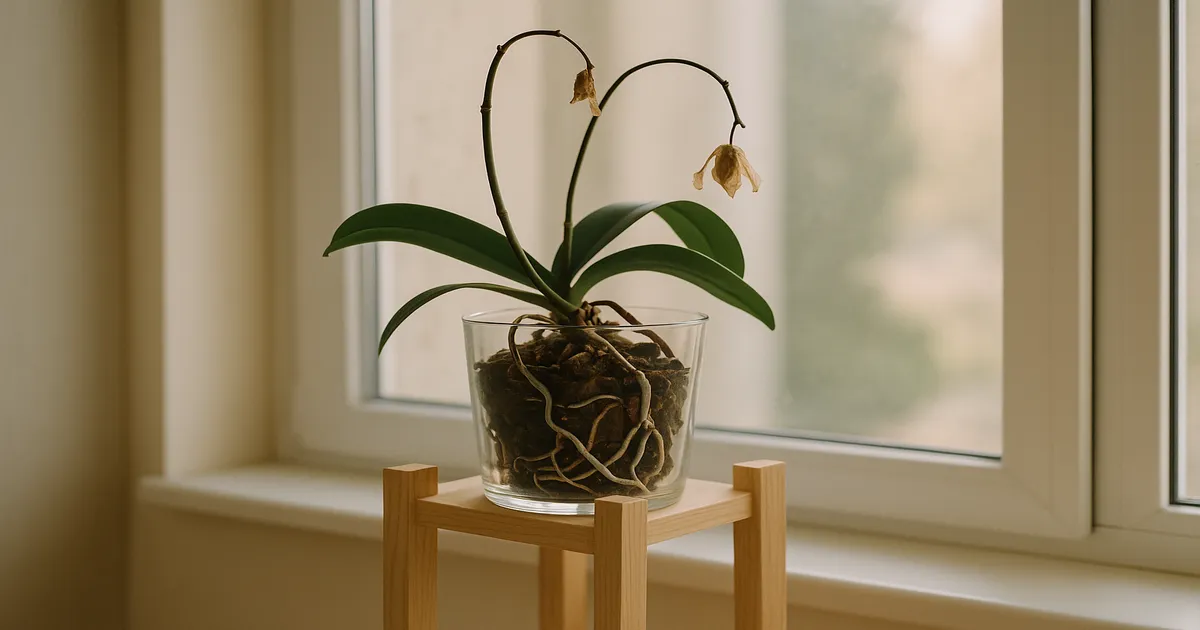
Quick Answer: The most common reason an orchid is dying is overwatering and the root rot that follows — but incorrect light, temperature stress, pests, and disease are close behind. The good news is that most orchids can be rescued with prompt action, and what looks like a dying plant is sometimes just a resting one.
Why Is My Orchid Dying? The Most Common Culprits
Orchids have a reputation for being difficult, but they usually decline for predictable, fixable reasons. Here’s the short list:
- Overwatering and root rot — the #1 killer by a wide margin
- Underwatering or low humidity — especially in heated winter homes
- Too little or too much light
- Temperature extremes — cold drafts, heat vents, and windowsill chill
- Pest infestations — scale, mealybugs, and spider mites
- Fungal, bacterial, or viral disease
- Wrong potting medium or fertilizer
How to Tell If Your Orchid Is Truly Dying or Just Resting
Before you panic, check the roots. Orchid roots are coated in a spongy tissue called velamen — it turns silver-gray when dry and bright green when hydrated. Healthy roots are plump and firm in either color. Rotted roots are brown, mushy, and hollow.
Also worth knowing: many orchids drop their flowers and enter a natural rest period that can look alarming. A Phalaenopsis that has dropped all its blooms and isn’t pushing new leaves may simply be dormant — not dying. If the roots and leaves look healthy, give it time.
Overwatering and Root Rot: The Number One Reason Orchids Die
Why Epiphytic Orchids Are So Vulnerable
Most popular houseplant orchids — Phalaenopsis, Cattleya, Dendrobium, Oncidium — are epiphytes. In nature, they cling to tree branches where their roots are exposed to air, soaked by rain, and then dried quickly. They are not designed to sit in soggy soil.
When roots stay wet too long, oxygen is displaced from the medium and anaerobic conditions develop. Pathogens like Pythium, Phytophthora, and Fusarium move in fast. The cruel irony: rotted roots can’t deliver water to the plant, so an overwatered orchid wilts and yellows exactly like a thirsty one.
Several factors make overwatering worse:
- Pots without drainage holes
- Standard potting soil instead of chunky bark
- Low light (the plant uses less water)
- Cold temperatures (evaporation slows dramatically)
- Oversized pots that hold excess moisture around the root zone
What Healthy vs. Rotted Roots Look Like
Healthy roots are firm and plump — white to silver-gray when dry, vivid green when freshly watered. Rotted roots are brown or black, mushy, and hollow. Squeeze one and it may collapse like wet paper. A clear plastic nursery pot makes this inspection easy without unpotting the plant.
If you see any mushy roots, act immediately — rot spreads fast.
How to Save an Orchid with Root Rot
- Remove the plant from its pot and shake off all the old medium.
- Rinse roots gently under lukewarm water.
- Trim every brown, mushy, or hollow root with sterile scissors — sterilize blades with 70% isopropyl alcohol between cuts.
- Dust all cut surfaces with powdered cinnamon (a natural antifungal) or a sulfur-based fungicide powder.
- Let the roots air-dry for 30–60 minutes.
- Repot into fresh, chunky orchid bark mix (medium-grade fir bark with perlite and horticultural charcoal).
- Water sparingly — wait until the roots turn silver-gray before watering again.
Underwatering, Low Humidity, and Dehydration Stress
Signs Your Orchid Is Dehydrated
Phalaenopsis is especially drought-sensitive because it has no pseudobulbs — no built-in water reserve. When it runs dry, the damage shows up fast:
- Wrinkled, leathery, or accordion-pleated leaves
- Shriveled pseudobulbs (on genera like Cattleya or Dendrobium)
- Roots that stay silver-gray even after watering, a sign the medium has become hydrophobic and is shedding water rather than absorbing it
- Bud blast: flower buds yellowing and dropping before they open
Miltoniopsis (Pansy Orchid) and Paphiopedilum (Lady’s Slipper) are particularly sensitive to drying out. If you grow either, check moisture levels more often than you would for a Phalaenopsis.
Why Indoor Air Is Often Too Dry
Tropical orchids prefer 50–70% relative humidity. In a heated home during winter, indoor humidity often drops to 20–30% — low enough to pull moisture out of leaves faster than roots can replace it. A digital hygrometer takes the guesswork out of monitoring conditions.
How to Rehydrate a Severely Dehydrated Orchid
For mild dehydration, switch to the soak-and-drain method: submerge the pot in room-temperature water for 15–20 minutes, then let it drain completely. Repeat weekly.
For a severely shriveled plant, try a humidity tent — place a clear plastic bag loosely over the plant for 48–72 hours. This allows gradual rehydration through the leaves and velamen without the risk of overwatering. Once the plant perks up, maintain ambient humidity with a cool-mist humidifier or a pebble tray, making sure the pot base sits above the waterline, not in it.
Light and Temperature Problems
Too Little Light
Insufficient light is one of the most common hidden causes of slow orchid decline. A light-starved plant can’t photosynthesize enough energy to grow new roots, resist disease, or rebloom. Signs include dark green limp leaves, failure to produce a new flower spike, and elongated weak new growth.
Light targets by genus:
- Phalaenopsis: bright indirect light (1,500–3,000 foot-candles) — an east-facing window is ideal
- Cattleya / Cymbidium: high indirect to filtered direct light (3,000–5,000 foot-candles) — south- or east-facing with a sheer curtain
If natural light is limited, a full-spectrum LED grow light positioned 6–12 inches above the plant and running 12–14 hours daily is a reliable fix.
Too Much Direct Sun
Direct summer sun through south- or west-facing windows can exceed 10,000 foot-candles — far beyond what any common houseplant orchid tolerates. Scorched leaves develop bleached, yellow, or papery brown patches, usually on the upper surface. The damage is permanent, but it won’t spread once you move the plant or add a sheer curtain. Transition light-stressed plants gradually over one to two weeks; a sudden move from bright to dim is its own kind of shock.
Cold Drafts, Heat Stress, and Crown Rot
Most tropical orchids need a minimum of 60°F (15°C) at night. Windowsill temperatures in winter can run 10–15°F colder than the rest of the room — check with a thermometer before placing any orchid there.
Cold damage shows up as water-soaked darkened patches on leaves, blackening of the crown, or sudden leaf drop. Crown rot — when cold water or chilled air sits in the central rosette of a Phalaenopsis — is particularly lethal and moves fast. Heat stress (consistently above 95°F / 35°C) causes wilting despite adequate watering and triggers bud blast. A small oscillating fan on low improves air movement and helps buffer temperature swings. And skip the ice-cube watering trick — localized cold shock damages velamen cells and offers no real benefit.
Pests That Can Kill Your Orchid
Scale, Mealybugs, and Spider Mites
Scale insects look like small brown, tan, or white bumps on leaves, stems, and pseudobulbs. They suck sap and excrete honeydew that promotes sooty mold. Mealybugs appear as white cottony clusters in leaf axils and root zones — they also inject toxins while feeding and spread quickly through a collection.
Spider mites thrive when humidity drops below 40%, leaving leaves with a silvery stippled appearance and fine webbing on the undersides. A severe infestation can devastate a plant in weeks.
Fungus Gnats, Thrips, and Aphids
Fungus gnat larvae feed on roots and organic matter in the potting medium, weakening an already-stressed root system. Thrips cause silvery streaking on new growth and can transmit viral diseases between plants. Aphids cluster on new growth and flower spikes and also spread viruses.
How to Treat Orchid Pests Safely
Isolate any infested plant immediately. This is non-negotiable.
- Scale / mealybugs: Dab individual insects with a cotton swab dipped in 70% isopropyl alcohol, then follow up with insecticidal soap or neem oil spray. Cover all surfaces — leaf undersides, crevices, root zone. Repeat every 7–10 days for at least three to four cycles.
- Spider mites: Raise humidity immediately — mites struggle to reproduce above 60% RH. Rinse the plant with water, then apply a spinosad-based miticide. Insecticidal soap is less effective against mites than it is against soft-bodied insects.
- Fungus gnats: Let the medium dry more thoroughly between waterings and apply a Bacillus thuringiensis israelensis (Bti) drench to kill larvae. Yellow sticky traps catch the adults.
Fungal, Bacterial, and Viral Diseases
Black Rot and Botrytis
Black rot (caused by Phytophthora and Pythium) spreads rapidly and can kill a plant in days if it reaches the crown. Botrytis (gray mold) causes brown spots on flowers and leaves, typically in cool, humid, stagnant conditions. Cut away all affected tissue with sterilized tools, apply a copper-based fungicide or cinnamon to the wound, and improve air circulation immediately. Never let water sit on leaves or in the crown overnight.
Bacterial Brown Rot and Fusarium Wilt
Bacterial brown rot (Erwinia spp.) produces water-soaked, foul-smelling lesions that spread with alarming speed in warm wet conditions. Cut out infected tissue aggressively, treat with hydrogen peroxide or a copper bactericide, and keep the crown dry. Fusarium wilt is slower but equally destructive — it invades vascular tissue, causing yellowing of individual pseudobulbs and sometimes producing pink spores. There is no systemic cure; remove and isolate affected plants.
Orchid Viruses: When There Is No Cure
Cymbidium Mosaic Virus (CymMV) and Odontoglossum Ringspot Virus (ORSV) are the most widespread orchid viruses. Symptoms include mosaic patterns, color breaks in flowers, necrotic streaks, and stunted growth. There is no treatment. Infected plants should be destroyed to protect the rest of your collection. Viruses spread via contaminated cutting tools and sucking insects, so sterilizing scissors with isopropyl alcohol between every cut is one of the most important habits you can build.
Repotting, Potting Medium, and Fertilizer Mistakes
When and Why to Repot
Bark-based potting media break down in 18–24 months, turning from chunky and airy to dense and soggy. When that happens, even correct watering habits can’t prevent root suffocation. Repot on schedule — don’t wait for obvious decline. Choose a pot only 1–2 inches larger than the root mass; a much larger pot holds excess moisture and invites rot.
Choosing the Right Potting Medium
The single most common potting mistake is using standard houseplant potting soil. It’s far too water-retentive for epiphytic orchids and will suffocate their roots. Use a chunky mix of medium-grade fir bark, perlite, and horticultural charcoal instead. If you prefer a pre-made blend, look for one specifically labeled for epiphytic orchids.
Fertilizing Correctly: The Weakly Weekly Method
Orchids evolved in nutrient-poor environments and are light feeders. Over-fertilizing causes salt burn — brown crispy root tips, leaf tip burn, and a white crust on the pot or medium surface. Under-fertilizing causes pale yellow-green leaves and poor root development.
The fix is simple: “weakly, weekly.” Use a balanced water-soluble fertilizer (20-20-20 or 20-10-20) at one-quarter the recommended dose, applied every week during active growth. Switch to a low-nitrogen, high-phosphorus formula (10-30-20) in late summer and fall to encourage blooming. Flush the medium with plain water once a month to leach accumulated salts. If you use reverse osmosis or rainwater, add a calcium-magnesium supplement to replace minerals those sources lack.
How to Keep Your Orchid Healthy Year-Round
Care requirements vary significantly between genera. A Cymbidium needs cool nights (50–55°F / 10–13°C) to bloom; a Phalaenopsis would suffer at those temperatures. Identify your orchid’s genus before settling on a care routine.
Core targets for most tropical houseplant orchids:
- Humidity: 50–70%
- Air circulation: gentle indirect airflow from a small fan
- Light: bright indirect light, matched to your specific genus
- Temperature: minimum 60°F (15°C) at night for warm-growers
A simple year-round routine:
- Water only when roots turn silver-gray — use the soak-and-drain method
- Fertilize weakly, weekly during active growth; reduce or stop during dormancy
- Repot every 18–24 months into fresh bark mix
- Inspect roots, leaves, and growing points weekly for early signs of pests or disease
- Quarantine any new plant for at least two weeks before it joins your collection
- Sterilize cutting tools between plants, every time
The velamen root color check is your single most useful daily diagnostic. Silver-gray roots that stay that way even after watering signal a hydration or root problem worth investigating. Yellowing lower leaves, wrinkled foliage, or soft new growth are all worth acting on early — before a small problem becomes a large one.
Frequently Asked Questions About Dying Orchids
Can a dying orchid be saved?
Yes, in most cases — if you catch the problem early enough. Root rot, dehydration, pest infestations, and light or temperature issues are all recoverable with prompt action. Viral disease is the main exception; there is no cure, and infected plants should be removed to protect others.
What do overwatered orchid roots look like?
Overwatered roots are brown, mushy, and hollow — they feel like wet paper when squeezed. Healthy roots are firm and plump, turning silver-gray when dry and bright green after watering. If you see brown mush, trim it away immediately with sterile scissors and repot in fresh bark.
Why are my orchid’s leaves turning yellow?
Yellow leaves can signal overwatering, underwatering, root rot, too little light, or natural aging of the lowest leaves. Start by checking the roots — if they’re mushy and brown, root rot is the likely culprit. If roots look healthy, reassess your light levels and watering frequency before assuming the worst.
How often should I water my orchid?
There’s no fixed schedule — it depends on your pot size, medium, humidity, and temperature. The reliable rule: water when the roots turn silver-gray and the medium is nearly dry. For most Phalaenopsis in a bark mix indoors, that works out to roughly once a week, but always let the roots guide you rather than the calendar.
Why are my orchid’s flower buds dying before they open?
Bud blast — buds yellowing and dropping before opening — is most commonly caused by low humidity, sudden temperature changes, cold drafts, or ethylene gas from nearby ripening fruit. Move the plant away from drafts, vents, and fruit bowls, and raise humidity to 50–70%. Orchids in bud are sensitive to any sudden environmental shift, so consistency is key.